Why AI Pilots Fail to Deliver Measurable Business ROI
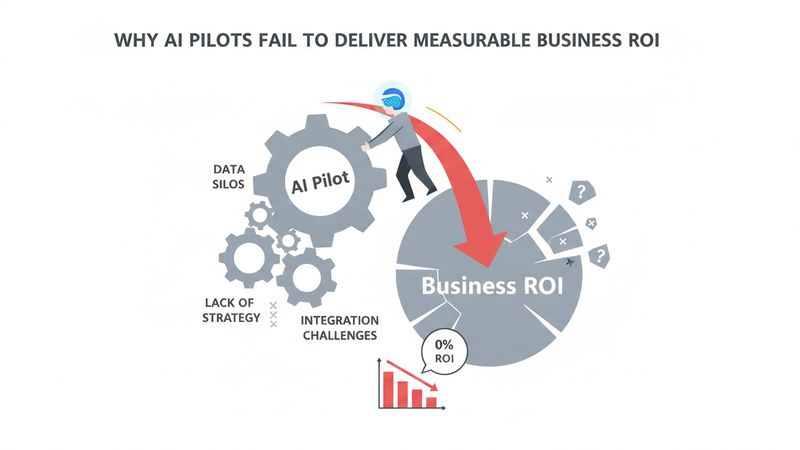
Nearly half of Canadian businesses are trapped in AI pilots with no ROI. Here is how operational redesign turns disconnected tech into measurable profit.
For mid-market executives and operational leaders across Canada, the initial excitement surrounding artificial intelligence has collided with a stark financial reality. While corporate boards pushed for rapid experimentation, recent industry data reveals that nearly 46% of Canadian organizations are running AI experiments without generating any measurable return on investment. Furthermore, research from MIT indicates that only 5% of generative AI pilots across industries have achieved concrete bottom-line P&L impact. The core issue is not model capability; it is that companies are applying enterprise AI workflow automation as isolated point solutions rather than embedding intelligence directly into operational architecture.
When technology investments fail to bridge disconnected systems and legacy infrastructure, executives end up funding activity rather than outcomes. To escape the pilot trap and capture tangible margin gains, leadership must pivot from individual seat licenses toward end-to-end operational integration.
The Disconnect Between Tech Activity and Business Value
Most enterprise AI rollouts over the past twenty-four months followed an identical pattern: buying software seats for knowledge workers or launching narrow chatbot experiments. While these tools allow individual employees to summarize documents or draft emails slightly faster, they do not resolve the systematic bottlenecks that drag down operational margins.
According to recent Canadian executive benchmarking, only 18% of businesses have successfully integrated AI into day-to-day workflows and core operations. The remaining majority suffer from three common structural flaws:
- Task Speed vs. Process Throughput: Accelerating a single task by five minutes does not improve delivery cycles if work still sits in multi-day approval queues or legacy enterprise resource planning (ERP) silos.
- Fragmented Data Architecture: AI tools deployed on top of unorganized, siloed data repositories generate inaccurate or generic outputs, preventing autonomous execution.
- Input-Based Metrics: Tracking license utilization or employee trial counts gives a false sense of digital progress without tying tech spend to cost takeout, error reduction, or cycle time acceleration.
When automation initiatives operate in isolated departmental silos, they add software overhead without reducing operational friction.
Real-World Scenario: The Mid-Market Operational Bottleneck
Consider a mid-sized industrial distributor based in the Greater Toronto Area managing $65 million in annual revenue. Under pressure to modernize, the executive team invested in commercial AI licenses for their sales, customer support, and procurement teams.
Six months into deployment, team members were individually satisfied with their software assistants, but executive leadership saw zero improvement in quarterly operating margins. An operational audit revealed why:
- Disconnected Handoffs: Inside sales reps used generative tools to draft client quotes in minutes, but the quote details still had to be manually re-keyed into an on-premise legacy ERP system.
- Manual Reconciliation: Customer order inquiries were triaged faster in front-line mailboxes, but confirming supplier lead times required cross-referencing three separate legacy databases.
- Compounding Friction: Because the AI tools could not validate data against operational inventory levels or financial credit limits in real time, warehouse fulfillment and invoice reconciliation experienced the exact same 48-hour lag as before.
The company was paying for modern front-end tools while remaining chained to disconnected manual back-office workflows. Real ROI only materialized when leadership replaced ad-hoc experimentation with a custom-engineered automation bridge connecting their CRM, inventory warehouse, and accounting engines.
Shifting from Disconnected Pilots to Integrated Systems
To move beyond surface-level productivity and achieve sustained margin expansion, business leaders must treat automation as an operational redesign rather than a software purchase. High-performing organizations focus on three foundational disciplines:
1. Map Complete Operational Workflows First
Before selecting tools or writing code, map the complete path of a transaction—from customer intake to settlement. Identify where human touchpoints exist merely to transfer data between incompatible systems. Automating low-value data re-entry and standardizing multi-step approvals yields immediate cycle-time reductions.
2. Connect Modern Logic to Core Systems
Value creation happens where artificial intelligence intersects with proprietary operational data. Modernization efforts must prioritize secure API integrations, structured middleware, and robust data pipelines that allow automated workflows to read and write directly into core ERPs, CRMs, and supply chain management databases.
3. Anchor Automation to P&L-Level Benchmarks
Replace vanity adoption metrics with strict financial and operational KPIs:
- Cycle Time Reduction: Decreasing average processing times for order fulfillment, claims, or onboarding from days to minutes.
- Throughput Capacity: Increasing operational volume handled per employee without adding administrative headcount.
- Error and Rework Rates: Eliminating costly manual entry mistakes and reconciliation overhead.
Building a Practical Modernization Roadmap
Transforming disconnected IT landscapes into streamlined, high-margin operations requires experienced technical execution. Off-the-shelf SaaS plugins rarely solve complex multi-system handoffs, while massive, multi-year core replacement projects carry severe delivery risk.
Toronto-based Arepitas Technologies Inc helps mid-market and enterprise organizations bridge legacy systems, eliminate operational drag, and build robust software integrations that produce clear business outcomes. Whether you need to connect legacy back-office databases, automate complex manual approval pipelines, or engineer purpose-built digital platforms, explore our tailored software engineering and modernization services to turn digital investments into measurable enterprise ROI.
By refocusing technology budgets around end-to-end operational architecture, Canadian executives can eliminate wasted pilot spending and establish a sustainable competitive advantage in their market.
Sources
Need help with ai & automation?
Arepitas Technologies Inc helps companies in Toronto build software, AI features, and digital products that scale.
Book a Free ConsultationRelated Articles
The Agentic AI Readiness Gap: Unlocking Workflow ROI
While Canadian firms rush toward autonomous workflows, a 97% agentic AI readiness gap risks millions in value. Here is how leaders close it for real ROI.
The AI Integration Dilemma: Turning Automation Into ROI
Canadian mid-market leaders are moving past experimental AI chatbots. Discover how connected agentic workflows eliminate hidden costs and drive measurable ROI.
Intelligent Document Automation: Cutting Back-Office Lag
Manual paperwork and fragmented reviews drain operating margins. Discover how intelligent workflow automation cuts cycle times and delivers measurable ROI.