The Software Migration Trap: De-Risking Core Systems
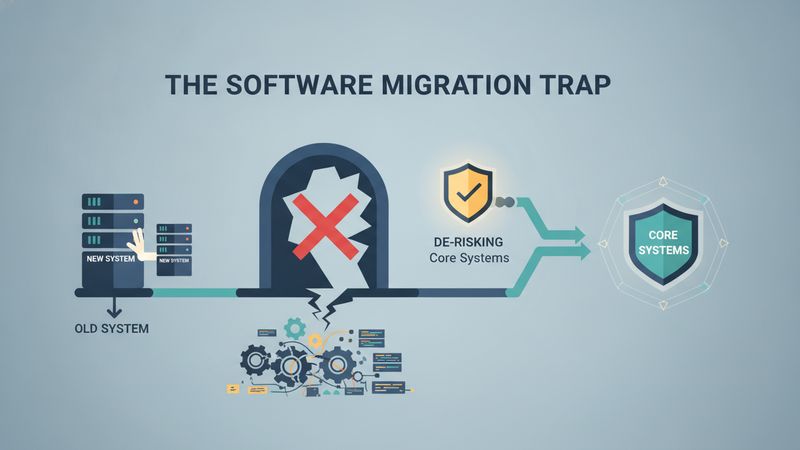
Nearly 80% of legacy software migration projects face catastrophic delays. Learn how Canadian business leaders de-risk cutovers and protect enterprise margins.
For mid-market and enterprise business leaders, few technology initiatives carry higher stakes than a core software migration. Whether transitioning away from an aging on-premise ERP, decoupling an overburdened SQL monolith, or replatforming customer-facing portals, modernizing legacy systems is essential to maintaining market agility. Yet industry research shows that between 70% and 88% of legacy migration initiatives fail to achieve their projected business outcomes, exceed their budgets, or stall entirely before delivery. When an organization runs mission-critical operations on software built over a decade ago, attempting to replace that core without disrupting revenue is the ultimate leadership challenge.
In competitive hubs like Toronto, Waterloo, and across Canada, mid-market companies in supply chain logistics, insurance, and specialty financial services are finding that the cost of delay is compounding at nearly 20% each year. Up to 80% of corporate IT budgets are swallowed by patch management, legacy compliance workarounds, and niche talent retainers. However, business leaders who rush into wholesale platform rewrites often trade routine maintenance headaches for operational paralysis. Modernizing successfully requires moving past outdated execution playbooks and approaching software migration as a value-gated risk management strategy.
The Anatomy of the Migration Trap: Why Big-Bang Swaps Backfire
The most common mistake executive teams make during a core software migration is committing to the "big-bang" cutover. In this scenario, engineering builds a shiny replacement system in parallel over 12 to 24 months, with plans to flip the switch in an all-or-nothing weekend rollout. While tempting on paper, this approach repeatedly collapses under real-world operational pressure for several predictable reasons:
- Undocumented Edge Cases: Enterprise systems aggregate hundreds of unspoken business rules over years of use. Hidden exception workflows—often buried in legacy database procedures or desktop spreadsheets—only surface once the legacy system is turned off, halting order processing and invoicing.
- Data Integrity and Schema Drift: Moving millions of relational records into modern event-driven or cloud schemas is rarely a direct translation. Data drift, corrupted historical records, and missing validation layers lead to costly post-launch data reconciliation.
- Organizational Change Fatigue: Frontline operations teams cannot absorb a completely overhauled workflow overnight. Forcing a sudden platform cutover without transitional interfaces sparks user resistance, spikes error rates, and severely degrades customer experience.
- Runaway Scope and Burnout: Operating dual architectures for years while trying to hit a moving business target leads to scope creep. Key technical personnel burn out, and leadership loses confidence before the first production transaction runs.
The Strategic Decision Framework: Modernize, Encapsulate, or Rebuild?
Before allocating capital, leadership must evaluate where the system sits on the risk-versus-value spectrum. Successful Canadian enterprises rely on an objective evaluation framework to select the appropriate migration path:
1. The Strangler Fig Pattern (Incremental Migration)
Instead of rewriting the entire system at once, high-performing engineering teams wrap legacy cores with modern API gateways and gradually replace functional domains piece by piece. For example, a logistics provider in Southern Ontario might carve out dispatch scheduling and rate quoting into modular services while leaving the legacy ledger intact. This pattern reduces cutover risk to zero downtime and delivers measurable business ROI within the first 90 days.
2. Encapsulation and Web Augmentation
When core legacy code is mathematically stable but impossible to integrate with modern third-party tools or AI-driven workflows, direct replacement is often unnecessary. By building resilient API wrappers and modern web portals directly over the legacy backend, companies unlock seamless self-service capabilities without spending millions on database rewrites.
3. Purpose-Built Rearchitecting
Complete ground-up rewrites are reserved strictly for architectures where the underlying technology is obsolete, security vulnerabilities cannot be patched, or developer talent is nonexistent. When this path is chosen, programs must be structured around value-gated milestones rather than monolithic completion dates.
| Assessment Factor | Encapsulate (Layer) | Strangler Fig (Phased) | Complete Rebuild |
|---|---|---|---|
| Core Business Logic | Highly valuable, fragile | Complex but modularizable | Irreparably broken |
| Timeline to ROI | 2 to 3 months | 3 to 6 months per domain | 12 to 18+ months |
| Budget Expectation | $40K – $90K CAD | $120K – $350K CAD | $400K – $1.2M+ CAD |
| Cutover Disruption | Minimal / zero | Controlled rollbacks | High business exposure |
Budget and Timeline Benchmarks for Executives
When planning a software migration project, mid-sized organizations must establish realistic budgetary envelopes. Industry benchmarks demonstrate that budgeting based solely on code volume is a recipe for overrun; scoping must account for business integration and discovery.
- Discovery & Architecture Audit (Weeks 1–4, $15,000 – $35,000 CAD): Mapping hidden dependencies, validating data models, and designing domain boundaries before writing production code.
- Phase 1 Pilot Migration (Months 2–4, $60,000 – $120,000 CAD): Isolating the single highest-value workflow, deploying an incremental service, and proving production parity under live user traffic.
- Continuous Domain Rollouts (Months 5–12, $30,000 – $60,000 CAD/month): Systematically retiring legacy modules while monitoring application performance and data synchronicity.
Aligning With the Right Technical Partner
Software migrations require a specialized engineering partner experienced in strangler architectures, resilient data pipelines, and legacy modernization. Operating teams need seasoned technical consultants who evaluate software through the lens of EBITDA preservation, business continuity, and risk mitigation rather than just code velocity.
Based in Toronto, Arepitas Technologies Inc works alongside executive teams across Ontario and Canada to de-risk complex software migrations. By conducting thorough legacy audits and executing domain-driven modernizations, Arepitas ensures your critical business workflows remain operational, secure, and ready for future scale. Explore our specialized modernization and software architecture services to build an incremental roadmap that turns legacy technical debt into a decisive competitive advantage.
Sources
Need help with software migrations?
Arepitas Technologies Inc helps companies in Toronto build software, AI features, and digital products that scale.
Book a Free ConsultationRelated Articles
The Data Migration Trap: Stopping Costly Cutover Delays
With 83% of data migrations exceeding budgets or timelines, business leaders must ditch big-bang cutovers for pragmatic, phased modernizations that protect ROI.
The Legacy Database Drain: Escaping Proprietary Lock-In
Escalating per-core vendor fees drain enterprise margins. Learn how strategic legacy database migration cuts TCO by up to 70% while boosting system agility.
The Cloud Compute Squeeze: Cutting Costs via Migration
Tired of skyrocketing cloud bills? Targeted microservice migrations slash compute overhead by up to 70% without the risk and expense of full software rewrites.