The Data Migration Trap: Stopping Costly Cutover Delays
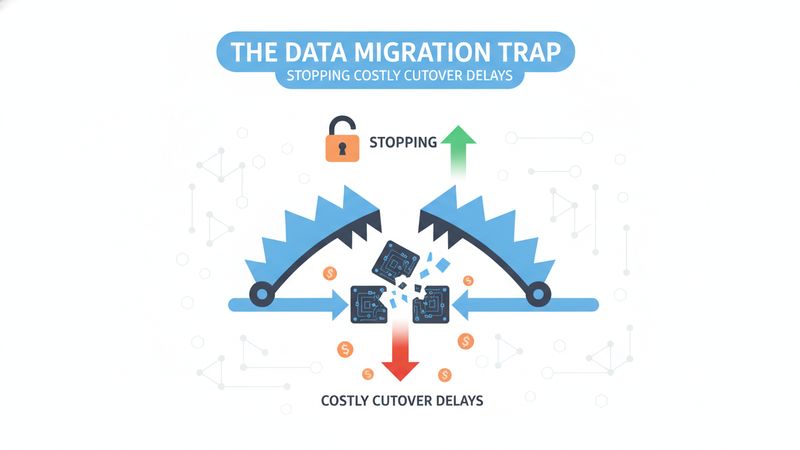
With 83% of data migrations exceeding budgets or timelines, business leaders must ditch big-bang cutovers for pragmatic, phased modernizations that protect ROI.
According to industry research from analyst firms including Gartner, more than 83% of data migration initiatives either fail outright, suffer crippling time delays, or overrun their planned budgets. Even more alarmingly, the average cost overrun on core enterprise migrations sits around 30%, with schedule slippages routinely stretching past 40%. For executive decision-makers, a data migration is rarely just an engineering task; it is an existential business transition. When historical transaction records, customer registries, or inventory states fail to cut over cleanly, revenue freezes, field teams lose visibility, and customer trust evaporates overnight.
Yet across Canada—from financial institutions along Bay Street in Toronto to fast-scaling logistics hubs in Mississauga and Kitchener-Waterloo—companies continue to treat migration as an operational afterthought. Leaders sign off on monolithic, "big-bang" cutover weekends only to wake up on Monday morning facing scrambled schemas, corrupted balances, and stalled commerce. Avoiding this operational hemorrhage requires leadership teams to rethink how core systems are untangled, verified, and phased into production.
The Anatomy of the Migration Hangover
Why do mission-critical migrations derail so predictably? The breakdown almost never happens inside modern destination clouds like AWS or Azure. Instead, it stems from the hidden debt of the legacy system being replaced:
- Semantic Data Drift: Legacy databases accumulate decades of undocumented schema workarounds, orphaned records, and conflicting formatting conventions. When engineering teams attempt automated, one-pass extraction without deep domain mapping, business logic shatters upon ingestion.
- The "Testing Theatre" Trap: Teams often run basic script validations that confirm row counts match between source and destination tables. However, verifying that a million rows transferred does not confirm that billing calculations, discount logic, or time zones converted accurately.
- The Dual-Run Burden: When a cutover falters, organizations are forced into unplanned hybrid operations, maintaining legacy hardware licensing, cloud subscriptions, and manual reconciliation teams simultaneously. This dual-run drag can quickly burn through hundreds of thousands of dollars in unbudgeted capital.
For mid-sized and scaling Canadian businesses, the stakes are heightened by tighter operational margins and rigorous data residency rules under PIPEDA and provincial privacy statutes. A delayed migration does not just inflate consulting invoices; it paralyzes product roadmaps and leaves executives defending cost overruns to boards and investors.
Moving Past Big-Bang Cutovers to Phased Modernization
Progressive technology leaders have abandoned the risky "all-at-once" weekend cutover in favor of progressive architectural patterns that guarantee operational continuity.
1. Adopt the Strangler Fig Pattern
Rather than rebuilding and migrating entire monoliths simultaneously, successful migrations isolate critical functional domains—such as checkout, account servicing, or reporting—and migrate them piece by piece. By routing live traffic incrementally through an API gateway, organizations validate production stability with zero catastrophic cutover risk.
2. Implement Real-Time Dual-Write and Shadow Pipelines
Before decommissioning legacy infrastructure, establish bi-directional sync or real-time data pipelines (using tools like Kafka or Debezium). Running shadow validation allows business teams to cross-verify production outputs in real time for weeks without exposing customer workflows to cutover downtime.
3. Treat Migration as Product Engineering
Data migration should not be dumped onto internal product developers already juggling core sprint commitments. It demands dedicated schema governance, synthetic load testing, rollback automation, and strict acceptance criteria tied directly to revenue metrics, not just database completion counters.
The Executive Decision Framework: Timelines and Budgets
When evaluating a core software or database modernization, executives should weigh internal delivery against specialized execution partners. Realistic budget and timeline parameters help benchmark expected spend:
- Targeted Domain Migration (3–5 months): Migrating a single high-friction subsystem (e.g., billing, inventory reporting) typically requires an investment of $60,000 to $140,000 CAD, offering immediate performance gains and reduced technical risk.
- Comprehensive Core Platform Cutover (6–10 months): De-risking an entire legacy ERP, custom CRM, or relational database estate through parallel running and automated reconciliation generally ranges from $150,000 to $350,000+ CAD depending on volume, schema complexity, and compliance requirements.
- The Inaction Multiplier: Retaining an unstable legacy core while patching recurring integration errors diverts an estimated 20% to 40% of standard IT budgets toward low-value maintenance, costing far more over two fiscal quarters than structured modernization.
If your engineering organization is bogged down resolving manual data discrepancies or your teams are bracing for a high-risk system transition, outside expertise can provide the governance, automated tooling, and architectural safeguards needed to guarantee a smooth transition. Toronto-based technology consultancy Arepitas Technologies Inc specializes in de-risking complex cloud platforms, system refactoring, and enterprise modernizations. Explore how our tailored software services help Canadian businesses cut operational overhead, retire legacy liabilities, and transition critical infrastructure with zero operational downtime.
Building Predictable Velocity for the Future
A software migration should never be a high-stakes bet where leadership holds its breath over a weekend. By adopting automated data pipelines, domain-driven strangler architectures, and rigorous business-level verification, companies protect their operational margins and turn modern systems into true growth catalysts.
Sources
Need help with software migrations?
Arepitas Technologies Inc helps companies in Toronto build software, AI features, and digital products that scale.
Book a Free ConsultationRelated Articles
The Legacy Database Drain: Escaping Proprietary Lock-In
Escalating per-core vendor fees drain enterprise margins. Learn how strategic legacy database migration cuts TCO by up to 70% while boosting system agility.
The Cloud Compute Squeeze: Cutting Costs via Migration
Tired of skyrocketing cloud bills? Targeted microservice migrations slash compute overhead by up to 70% without the risk and expense of full software rewrites.
Legacy Software Migration: The Executive Buyer's Guide
Planning a legacy software migration? Here is a practical framework to evaluate budgets, eliminate cutover risk, and protect your margins without downtime.