The Legacy Database Drain: Escaping Proprietary Lock-In
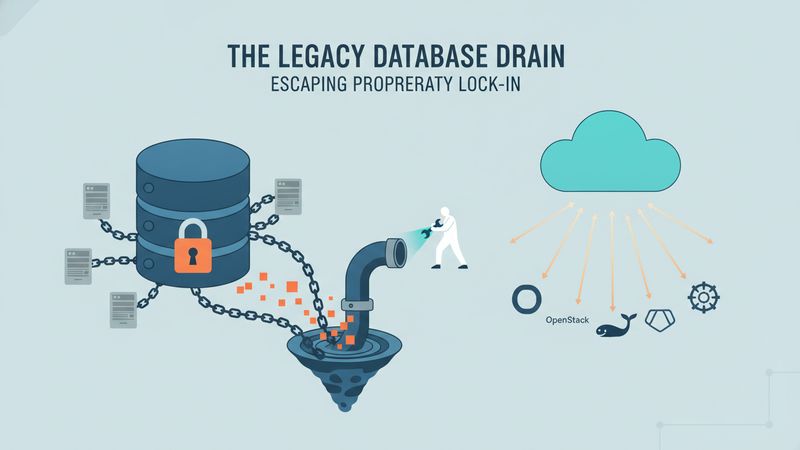
Escalating per-core vendor fees drain enterprise margins. Learn how strategic legacy database migration cuts TCO by up to 70% while boosting system agility.
For mid-market enterprises and established financial service firms across Toronto and the broader Canadian corridor, proprietary database renewals have evolved from routine operational expenses into punishing balance-sheet liabilities. If your technical roadmap is constrained by five-figure per-core license tiers, mandatory annual maintenance contracts, and rigid commercial lock-in, your organization is likely facing the hidden costs of outdated data infrastructure. Undertaking a strategic legacy database migration to open-source and managed cloud-native platforms like PostgreSQL is no longer merely an architectural preference for technical teams—it is an urgent capital reallocation priority for executive leadership.
When legacy database engines were embedded into mission-critical systems a decade or more ago, proprietary relational systems offered stability and support guarantees that few alternatives could match. Today, those legacy platforms frequently act as digital toll booths. Between punitive multi-core licensing formulas, proprietary clustering surcharges, and costly vendor audit cycles, business leaders routinely find that maintaining existing databases starves funding for product innovation, digital customer experience, and artificial intelligence initiatives.
The True Financial Drag of Proprietary Database Stacks
To understand why database modernizations have surged to the top of executive agendas, leadership must examine total cost of ownership (TCO) beyond initial software acquisition. Industry benchmarks reveal that proprietary enterprise database licenses typically command tens of thousands of dollars per physical or virtual core. On top of that, standard annual vendor maintenance and support contracts add an automatic 20% to 22% premium year after year, with supplementary features like partitioning, advanced encryption, and disaster recovery adding another 40% to 70% to base expenses.
According to recent IT cost analyses by organizations like Synoptek, organizations routinely underestimate legacy system overhead by 40% to 60% because maintenance outlays are scattered across disjointed departmental budgets. When proprietary databases run on cloud infrastructure, the financial impact intensifies: major vendors enforce restricted licensing equivalencies that make cloud-hosted instances substantially more expensive than equivalent on-premises deployments.
Beyond direct invoices, enterprise leaders must reckon with three structural business bottlenecks:
- Developer and Deployment Friction: Proprietary stored procedures (such as legacy PL/SQL or Transact-SQL dialects) trap core business rules inside database engines, turning simple feature additions into months-long deployment risks.
- Talent Scarcity and Compounding Costs: Finding experienced administrators and developers willing to manage 15-year-old proprietary systems in competitive tech hubs like Ontario requires inflating compensation premiums, while modern engineering talent gravitates toward open, composable stacks.
- AI and Cloud Decoupling Barriers: Modern operational workflows—from real-time analytics to vector search and Retrieval-Augmented Generation (RAG)—require flexible, scalable datastores with extensions like
pgvector. Legacy proprietary databases restrict agility with closed ecosystems and costly add-on modules.
The Executive Decision Framework: When and How to Modernize
Migrating away from entrenched systems is rarely an overnight shift. Attempting a complete, "big bang" overhaul of a core transactional engine introduces unnecessary operational risk. A modern enterprise migration demands a disciplined, risk-adjusted migration framework that isolates dependencies and preserves business continuity.
1. Portfolio Assessment and Code Decomposition
Before touching live records, evaluate your workloads across two criteria: business criticality and proprietary complexity. Applications relying on standard SQL queries can often transition to managed PostgreSQL (such as Amazon RDS, Aurora, Google Cloud SQL, or Azure Database) with rapid automation. Conversely, workloads with deeply embedded procedural triggers and heavy stored procedures require refactoring business logic out of the database layer and into modern microservices or decoupled APIs.
2. Zero-Downtime Data Synchronization
For revenue-generating systems, extended cutover maintenance windows are rarely acceptable. Modern migration architectures leverage Change Data Capture (CDC) replication pipelines. The target PostgreSQL database operates concurrently in read-only mode, synchronizing continuous production updates alongside the legacy database until comprehensive schema validation, regression testing, and performance profiling are complete. The final operational cutover takes minutes rather than days.
3. Calculating Budget Expectations and Payback Periods
For mid-sized organizations with core database estates spanning 2TB to 20TB, typical end-to-end database migration engagements range from $60,000 to $250,000 CAD, depending on schema complexity, custom data types, and application dependencies. Case studies compiled by Newt Global demonstrate that enterprise licensing cost reductions consistently exceed 65% to 80% following migration to managed PostgreSQL. For most mid-market businesses, the eliminated annual maintenance contracts allow the modernization investment to achieve full ROI payback within 12 to 18 months.
Evaluating the In-House vs. Development Partner Decision
While internal engineering teams understand your company's day-to-day domain workflows, full-scale database migrations require niche data-engineering capabilities that internal product squads rarely execute regularly. Pulling full-time product engineers away from your commercial roadmap to manage schema translations, data indexing quirks, and network cutovers introduces missed market opportunities and burn-out risks.
Partnering with a specialized software engineering consultancy ensures that target cloud architectures are optimized for cost, security, compliance, and long-term performance. Working with a dedicated team based in Toronto, such as Arepitas Technologies Inc, provides executive teams with hands-on technical governance, proven data migration pipelines, and minimal business disruption throughout each modernization phase.
Reclaiming Strategic Flexibility
Modernizing away from legacy database lock-in is fundamentally an economic decision. By shifting your underlying transaction layers to versatile open-source platforms like PostgreSQL, your business gains full autonomy over compute spend, avoids punitive licensing renewal deadlines, and creates an elastic foundation prepared for modern cloud architectures and AI capabilities.
If rising enterprise software overhead and proprietary renewal contracts are throttling your product roadmap, explore the engineering capabilities available through our software development and migration services or reach out to evaluate your organization's modernization roadmap.
Sources
Need help with software migrations?
Arepitas Technologies Inc helps companies in Toronto build software, AI features, and digital products that scale.
Book a Free ConsultationRelated Articles
The Cloud Compute Squeeze: Cutting Costs via Migration
Tired of skyrocketing cloud bills? Targeted microservice migrations slash compute overhead by up to 70% without the risk and expense of full software rewrites.
Legacy Software Migration: The Executive Buyer's Guide
Planning a legacy software migration? Here is a practical framework to evaluate budgets, eliminate cutover risk, and protect your margins without downtime.
The Software Migration Trap: De-Risking Core Systems
Nearly 80% of legacy software migration projects face catastrophic delays. Learn how Canadian business leaders de-risk cutovers and protect enterprise margins.