The Cloud Compute Squeeze: Cutting Costs via Migration
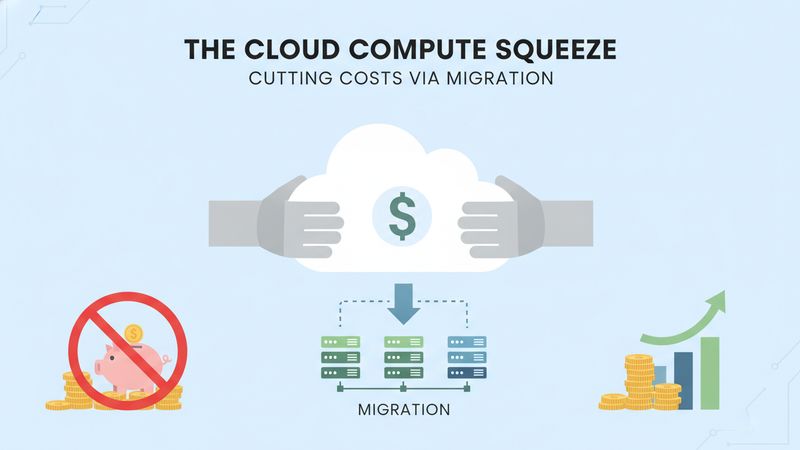
Tired of skyrocketing cloud bills? Targeted microservice migrations slash compute overhead by up to 70% without the risk and expense of full software rewrites.
As Canadian mid-market enterprises and high-growth scale-ups expand their customer bases, many leadership teams encounter a baffling balance-sheet contradiction: revenue is climbing, but cloud infrastructure bills are rising even faster. For years, software organizations prioritized raw development speed over runtime efficiency, assembling applications with interpreted or garbage-collected languages like Python, Ruby, and Node.js. While this accelerated initial time-to-market, high-traffic systems eventually collide with the cloud compute squeeze—a scenario where massive Kubernetes clusters, multi-gigabyte memory footprints, and compute-heavy API workers cannibalize gross margins.
Faced with six-figure AWS or Azure monthly invoices, executive teams frequently assume they have only two options: endure endless micro-optimization audits or embark on a multi-million-dollar "big bang" software rewrite. Both paths carry steep liabilities. Broad architectural rewrites have a notorious reputation in enterprise IT, with research from industry analysts showing that between 70% and 88% of large-scale legacy modernization initiatives fail to achieve their projected business outcomes, derail their budgets, or stall entirely.
Today, forward-thinking CTOs and finance directors are adopting a far more capital-efficient alternative: targeted runtime software migrations. By isolating high-throughput, compute-intensive bottlenecks and migrating only those specific services to modern compiled runtimes like Go or Rust, organizations are achieving 40% to 70% reductions in underlying server costs while preserving their broader application ecosystem.
Why the Compute Squeeze Drains Corporate Margins
The root of runaway cloud expenditure rarely lies across the entire software footprint. In most enterprise platforms, the Pareto Principle applies: roughly 10% to 20% of services consume 80% of CPU cycles and memory allocations. These high-load services typically include real-time payment processing, fraud detection, authentication layers, complex JSON data parsing, or high-volume asynchronous message queues.
When these bottleneck services run on interpreted frameworks, several financial penalties compound:
- The Memory Bloat Multiplier: Interpreted runtimes and standard managed virtual machines often require hundreds of megabytes—or even gigabytes—of RAM per container instance just to idle. Because public cloud providers bundle CPU and memory pricing tiers, oversized memory requirements force companies to purchase higher-tier compute instances than their actual calculations demand.
- Garbage Collection Latency Spikes: Unpredictable garbage collection pauses introduce tail latency (p99 latency spikes). To ensure customer-facing Service Level Agreements (SLAs) are maintained during peak hours, engineering teams are forced to aggressively over-provision auto-scaling thresholds, paying for idle capacity throughout the day.
- Horizontal Scaling Overhead: Multiplying application containers across clusters requires expanded networking infrastructure, higher load balancer capacities, and elevated licensing charges for application performance monitoring (APM) tools that bill per host or per core.
For a Toronto fintech platform processing millions of daily transactions, an unoptimized payment microservice cluster running on AWS can easily cost $35,000 to $60,000 CAD per month just to absorb unpredictable traffic spikes. Over three years, that compute footprint quietly bleeds over $1.5 million in cash that could otherwise fund product development or customer acquisition.
The Targeted Migration Playbook: Precision Over Paralyzing Rewrites
Rather than tearing down monolithic systems or re-platforming full application suites, modern software migrations leverage the Strangler Fig pattern at the runtime layer. The goal is not technological purity; it is direct cost extraction with minimal business disruption.
1. Profiling the True Cost Hotspots
Before writing a line of code, technical leaders conduct cloud cost telemetry mapping. By correlating AWS Cost Allocation Tags or Datadog metrics directly with microservice execution endpoints, teams pinpoint the exact 1 to 3 services driving the majority of compute bills. If a service processes modest traffic and accounts for only $800 a month in hosting, migrating it delivers virtually zero business return. Only services with high queries-per-second (QPS) and heavy data manipulation justify a runtime migration.
2. Matching the Runtime to the Economic Objective
Not every service requires the same destination language. While Rust offers industry-leading memory efficiency and eliminates runtime garbage collection—often yielding up to 70% infrastructure reductions—it has a steeper engineering learning curve. For many compute-heavy services, migrating to Go offers a balanced alternative, slashing server costs by 30% to 50% while maintaining rapid team onboarding and feature release speeds. Selecting the runtime based on business payback rather than developer hype prevents productivity stalls.
3. Canary Rollouts and Parallel Running
A zero-risk migration runs the newly written service in parallel with the legacy service, shadowing live production traffic. Input payloads are processed by both systems simultaneously, with responses compared in real time to verify byte-for-byte behavioral consistency. Once data parity and error tolerances are validated, traffic is progressively cut over via API gateways with zero downtime for end users.
Budget Framework: Costs, Timelines, and Payback ROI
When structured as a targeted initiative, migrating an isolated, high-cost microservice is highly predictable in both timeline and financial commitment:
- Project Timelines: A focused migration of an isolated backend service typically spans 8 to 12 weeks, encompassing reverse engineering of undocumented business rules, test suite replication, parallel validation, and production cutover.
- Investment Range: Mid-market organizations in Canada typically budget between $60,000 CAD and $140,000 CAD for specialized architecture, re-implementation, and QA auditing per high-volume service.
- Payback Window: When directed at services costing $15,000+ monthly in dedicated compute resources, a 50% to 70% reduction yields recurring savings of $7,500 to $10,500 every month. The entire capital outlay is typically recouped within 6 to 14 months, after which the gross margin expansion drops directly to the bottom line.
When to Engage an External Modernization Partner
In-house engineering teams are often already stretched thin maintaining existing features and meeting product roadmap commitments. Asking product developers to step away for three months to learn low-level concurrency or systems programming often causes roadmap delays and frustration.
Bringing in an experienced development partner provides dedicated execution without derailing core delivery cycles. Organizations like Arepitas Technologies Inc specialize in helping Canadian enterprises, scaling fintechs, and logistics firms audit infrastructure bottlenecks, architect clean runtime migrations, and de-risk core legacy systems. By pairing system-level performance expertise with rigorous migration testing frameworks, companies can capture significant hosting reductions and lock in lower ongoing operating costs without jeopardizing day-to-day operations.
If your platform's hosting bill is climbing faster than user growth, a big-bang rewrite is rarely the answer. A surgical software migration directed at your most expensive compute paths delivers immediate cash flow relief, strengthens platform stability, and safeguards your long-term operating margins.
Sources
Need help with software migrations?
Arepitas Technologies Inc helps companies in Toronto build software, AI features, and digital products that scale.
Book a Free ConsultationRelated Articles
The Data Migration Trap: Stopping Costly Cutover Delays
With 83% of data migrations exceeding budgets or timelines, business leaders must ditch big-bang cutovers for pragmatic, phased modernizations that protect ROI.
The Legacy Database Drain: Escaping Proprietary Lock-In
Escalating per-core vendor fees drain enterprise margins. Learn how strategic legacy database migration cuts TCO by up to 70% while boosting system agility.
Legacy Software Migration: The Executive Buyer's Guide
Planning a legacy software migration? Here is a practical framework to evaluate budgets, eliminate cutover risk, and protect your margins without downtime.