The Operational Resilience Gap: Modernizing Legacy IT
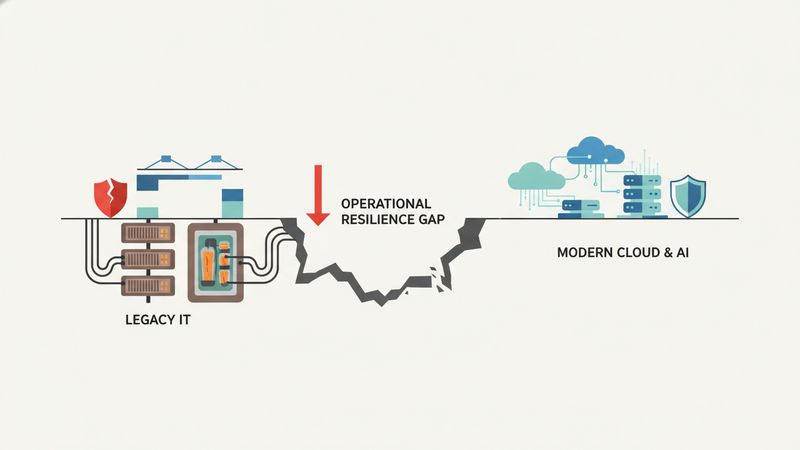
Canadian enterprises face mounting regulatory scrutiny and legacy operational risks. Here is how modern leaders decouple core workflows to stay competitive.
For executive teams across Canada, operational resilience has transitioned from an abstract IT governance checklist into a boardroom-level financial imperative. As regulatory frameworks tighten and supply chains become increasingly digital, mid-market enterprises and financial institutions in commercial hubs like Toronto are confronting a stark reality: aging technology stacks and brittle legacy workflows are actively choking operational agility, exposing businesses to steep regulatory penalties, and driving up operational overhead.
Recent data underscores the urgency. With the Office of the Superintendent of Financial Institutions (OSFI) enforcing Guideline E-21 on operational risk and resilience, Canadian organizations must prove that their operational processes can withstand major disruptions. Yet according to industry benchmark data, over 55% of executives report that legacy core infrastructure directly limits their market competitiveness, while the average Canadian data breach cost has climbed to CA$6.98 million. The friction between legacy IT and modern digital expectations is no longer just a technical debt issue—it is an existential business constraint.
The Hidden Business Toll of Brittle Legacy Infrastructure
Many organizations operate in complex, hybrid digital environments where decade-old core systems coexist uneasily with cloud tools and SaaS integrations. Over years of rapid growth, companies built temporary workarounds, custom scripts, and fragmented manual handoffs to keep data flowing between legacy databases and customer-facing interfaces.
Consider a mid-size financial services or logistics firm based in downtown Toronto: onboarding a new enterprise client requires querying three isolated back-office databases, verifying records manually across disconnected portals, and relying on batch processing that takes 72 hours. When an API call fails or a single server instance stalls, internal operations grind to a halt. While agile, cloud-native competitors execute onboarding in minutes, traditional firms spend hundreds of employee hours managing exceptions and reconciling mismatched records.
This operational drag manifests across several critical business dimensions:
- Compounded Cycle Times: Disconnected core applications force operations teams to execute repetitive data re-entry and verification, dragging down employee productivity and inflating labour costs.
- Elevated Outage and Security Risks: Legacy monolithic systems lack modern granular access controls and real-time observability, leaving organizations vulnerable to downtime and severe compliance audits.
- Slow Speed-to-Market: When launching a new digital product or partner integration requires months of fragile custom middleware development, leadership loses its first-mover advantage.
Regulatory Pressure and the Cost of Inaction in Canada
Canadian enterprises are operating under heightened macroeconomic and regulatory pressure. In a recent analysis by Deloitte Canada on regulatory modernization and economic productivity, leadership teams highlighted that mounting regulatory complexity demands smarter, more agile operational systems rather than slow, manual reporting mechanisms.
When regulators or enterprise clients demand detailed operational dependency mapping and real-time data integrity, organizations relying on opaque, siloed systems face direct supervisory penalties and reputational risk. Relying on spreadsheets and legacy core systems to generate audit trails is not only expensive—it introduces human error into critical legal disclosures.
Furthermore, Canadian SMBs now allocate between 4% and 7% of annual revenue to technology spend. When a significant portion of that budget is consumed simply maintaining obsolete infrastructure and patching legacy vulnerabilities, very little capital remains for strategic innovation, generative tooling, or revenue-generating software development.
A Pragmatic Playbook for Decoupled Modernization
Forward-thinking business leaders recognize that high-risk, all-or-nothing "rip-and-replace" overhauls rarely deliver predictable ROI. Instead, top-performing organizations modernize incrementally by decoupling critical workflows from legacy bottlenecks.
To bridge the operational resilience gap without interrupting day-to-day business operations, CTOs and operations directors should implement the following strategic steps:
1. Map High-Impact Value Streams
Before writing code, identify the specific business processes that create the highest operational friction or customer drop-off. Isolate the exact data exchanges between legacy cores and modern interfaces that cause latency or manual intervention.
2. Implement Resilient API Facades and Middleware
Wrap legacy systems in modern, secure API layers. By introducing an orchestration layer, you enable modern web, mobile, and automation tools to communicate with core databases without altering the underlying legacy codebase.
3. Automate Manual Validation and Reconciliation
Replace shadow spreadsheets and multi-step manual verifications with automated workflow engines. This immediately reduces cycle times, eliminates transcription errors, and creates automated, audit-ready compliance logs.
4. Establish Granular Observability and Failover
Ensure that every transaction, API interaction, and system dependency is tracked with real-time telemetry. If a legacy dependency encounters latency, automated fallback protocols should ensure business continuity without degrading the customer experience.
Turning Compliance into a Competitive Advantage
Achieving operational resilience is not merely a defense against regulatory sanctions or system downtime; it is a powerful growth catalyst. Organizations that successfully decouple their core operations can onboard partners faster, roll out digital features in weeks instead of quarters, and reallocate precious engineering and operations payroll toward strategic expansion.
Navigating legacy modernization requires an engineering partner that understands both robust enterprise architecture and local Canadian compliance landscapes. Arepitas Technologies Inc, a Toronto-based software engineering and digital transformation consultancy, partners with growing enterprises and mid-market leaders to modernize core workflows, build resilient integrations, and architect tailored software solutions that unlock long-term scalability. Explore our end-to-end technology services to discover how your organization can eliminate technical bottlenecks and achieve lasting operational agility.
Sources
- •How Canadian Banks Are Modernizing Legacy Systems in 2026 - VLink
- •New Deloitte Canada report series highlights smarter regulation as a catalyst for faster growth, investment, and productivity
- •IT Budget for Small Business Canada: 2026 Benchmarks by Size - Fusion Computing
- •Digital Transformation That Canada's Enterprises Can Govern - CIOReview
Need help with tech leadership & strategy?
Arepitas Technologies Inc helps companies in Toronto build software, AI features, and digital products that scale.
Book a Free ConsultationRelated Articles
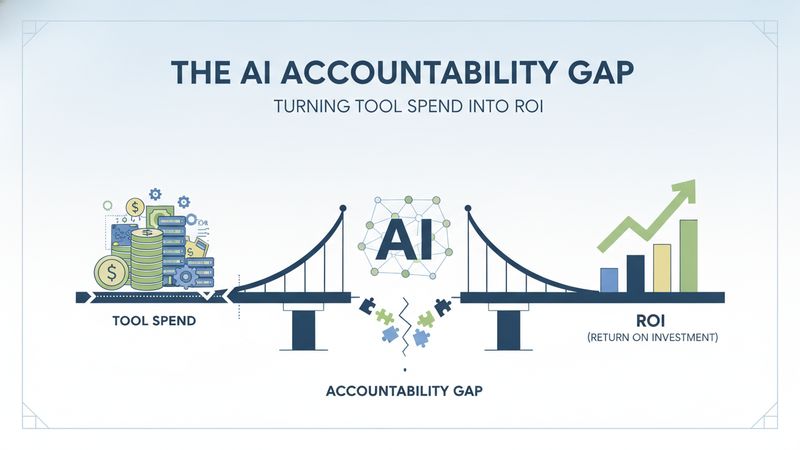
The AI Accountability Gap: Turning Tool Spend Into ROI
Canadian companies are spending 12x more on AI tools, but ad-hoc adoption is stalling ROI. Here is how executives bridge the AI accountability gap in 2026.
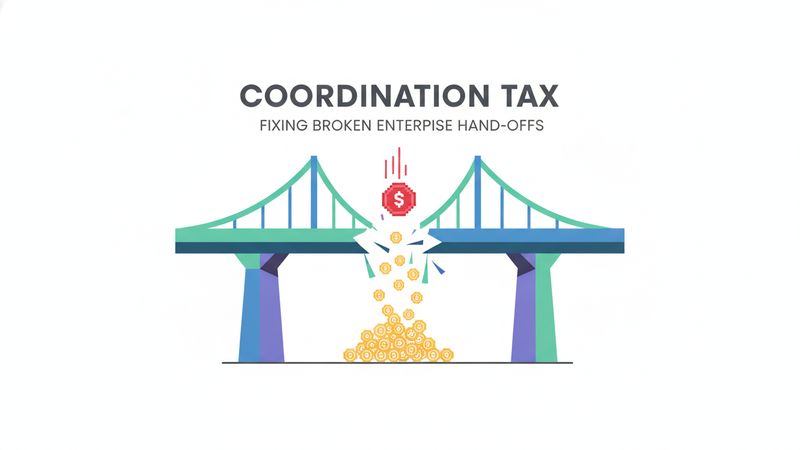
The Coordination Tax: Fixing Broken Enterprise Hand-Offs
Discover why the enterprise coordination tax stalls digital ROI and how Canadian leaders can automate cross-team hand-offs to protect operating margins.
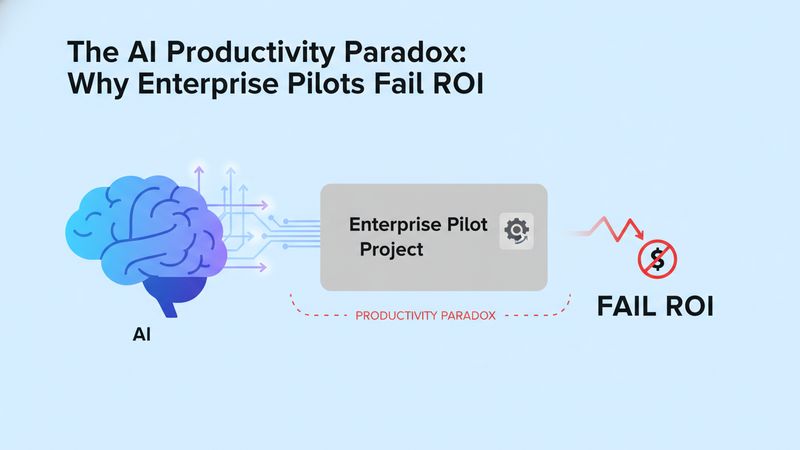
The AI Productivity Paradox: Why Enterprise Pilots Fail ROI
Canadian businesses are pouring millions into digital pilots, yet only 18% see real ROI. Here is how leaders turn experimentation into actual workflow gains.