The AI Accountability Gap: Turning Tool Spend Into ROI
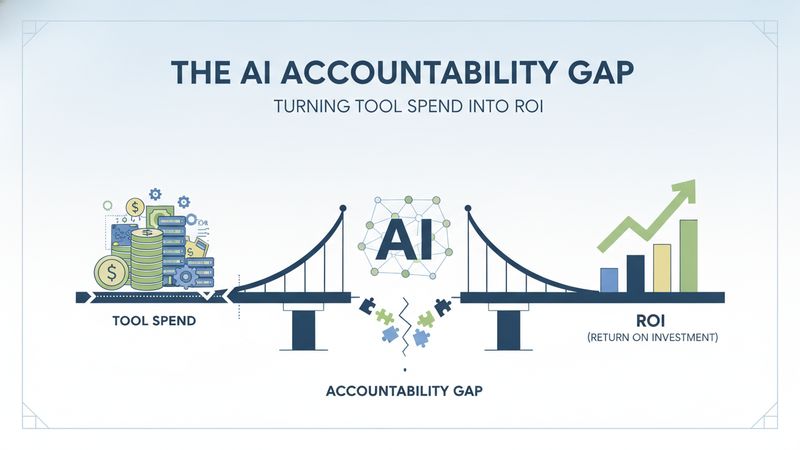
Canadian companies are spending 12x more on AI tools, but ad-hoc adoption is stalling ROI. Here is how executives bridge the AI accountability gap in 2026.
Canadian business leaders have spent the last twenty-four months aggressively expanding their technology budgets to adopt artificial intelligence. According to financial platform Float, Canadian businesses are spending roughly 12 times more on AI than they were just two years ago, with nearly half of all mid-market companies now paying for multiple AI platforms simultaneously. Yet across corporate boardrooms in Toronto, Vancouver, and Montreal, a frustrating reality has emerged: while tool adoption has soared, corresponding gains in operational margins, throughput, and cross-departmental productivity have failed to materialize.
This disconnect is known as the AI accountability gap. When software budgets scale faster than business outcomes, organizations end up with bloated SaaS line items, fragmented data, and disconnected teams. Closing this gap requires business leaders to pivot from decentralized tool procurement to structured, integrated workflow engineering.
The Anatomy of the AI Accountability Gap
The rush to adopt emerging technologies has created a multi-layered operational challenge for Canadian mid-market organizations:
- Point-Solution Sprawl: Departmental heads frequently license standalone AI copilots, chatbots, or document processors on corporate cards. Float's data reveals that over 51% of businesses now pay for competing model providers (such as OpenAI and Anthropic) at the same time, tripling the volatility of typical enterprise software spending.
- The Disconnected Hand-Off Problem: While individual employees use AI to draft summaries or analyze spreadsheets, the output must still be manually transferred, reviewed, and re-keyed into legacy enterprise resource planning (ERP) or customer relationship management (CRM) systems. The time saved on initial drafting is immediately lost in downstream administrative triage.
- Lack of Outcome-Driven KPIs: According to the CDW Canada AI Workplace Trends Report, daily workplace use of AI has jumped from 18% to 31% year-over-year. However, the research underscores that measurement and governance remain the primary barriers to value. Companies measure software seat consumption rather than cycle-time acceleration or error reduction.
A Real-World Scenario: The Mid-Market Bottleneck
Consider a mid-sized supply chain and commercial logistics provider in Mississauga, Ontario, generating $75 million in annual revenue. Over eighteen months, leadership approved various commercial AI tools across finance, logistics, and account management.
On paper, the company appeared digitally advanced. In practice, operational friction increased:
- The accounting department used an AI tool to extract invoice data from PDF documents.
- Because the tool was not integrated directly into the company’s customized legacy ERP system, clerks spent 15 hours per week validating extracted values and manually importing batch CSV files.
- Meanwhile, customer service used a separate AI chat interface that lacked real-time visibility into warehouse inventory, resulting in inaccurate shipment promises to key retail accounts.
The company was incurring thousands of dollars in monthly software licensing fees while its operational order-to-cash cycle remained stuck at nine business days. Technology spend had climbed significantly, but enterprise agility and customer satisfaction remained unchanged.
How Business Leaders Can Reclaim Control and ROI
Bridging the gap between software investment and tangible return requires shifting away from superficial apps toward cohesive digital systems. Progressive executives are taking four decisive steps:
1. Shift from Purchasing Tools to Architecting Workflows
Instead of evaluating standalone SaaS applications, map your core business processes from end to end. Identify where transactions stall, where data must be re-entered, and where manual oversight is genuinely necessary. Automating a fragmented workflow only accelerates errors; redesigning the workflow before introducing automation creates permanent operating leverage.
2. Connect Intelligent Layers to Core Systems of Record
Real enterprise efficiency occurs when automation interacts natively with your core databases, custom portals, and legacy applications. Custom integration pipelines—built with modern APIs, robust validation rules, and direct database connectors—eliminate the manual copy-pasting that currently erodes employee productivity.
3. Establish Concrete Operational Benchmarks
Replace vanity metrics like "number of active AI accounts" with hard business key performance indicators (KPIs):
- Cycle Time Reduction: How many hours were removed from customer onboarding or order processing?
- Error Rate Mitigation: Did automated reconciliation lower costly billing adjustments?
- Capacity Reallocation: Have operational personnel been redirected from data entry to higher-margin relationship management?
4. Consolidate Compute and Governance
Address redundant subscriptions by establishing centralized technology governance. By standardizing on consolidated API endpoints, implementing data privacy safeguards (in compliance with Canadian regulations such as PIPEDA and Bill C-27), and eliminating overlapping software licenses, companies typically reduce software spend while improving security posture.
Building Long-Term Operational Leverage
Digital modernization is not about accumulating licenses; it is about building reliable, tailored software that empowers your workforce and protects your margins. Organizations that treat software integration as a core strategic discipline outpace competitors by turning complex operational handoffs into automated, scalable advantages.
For companies seeking to replace disconnected software stacks with purpose-built systems, having an experienced technical engineering partner is essential. Based in Toronto, Arepitas Technologies Inc works closely with Canadian mid-market executives and operational leaders to modernize legacy software, streamline multi-system workflows, and build high-performance custom digital infrastructure. Explore our tailored software modernization and integration services to turn disconnected technology investments into measurable business value.
Sources
Need help with tech leadership & strategy?
Arepitas Technologies Inc helps companies in Toronto build software, AI features, and digital products that scale.
Book a Free ConsultationRelated Articles
The Coordination Tax: Fixing Broken Enterprise Hand-Offs
Discover why the enterprise coordination tax stalls digital ROI and how Canadian leaders can automate cross-team hand-offs to protect operating margins.
The AI Productivity Paradox: Why Enterprise Pilots Fail ROI
Canadian businesses are pouring millions into digital pilots, yet only 18% see real ROI. Here is how leaders turn experimentation into actual workflow gains.
The Operational Resilience Gap: Modernizing Legacy IT
Canadian enterprises face mounting regulatory scrutiny and legacy operational risks. Here is how modern leaders decouple core workflows to stay competitive.