The MVP Validation Trap: Why Early Launches Miss Market Fit
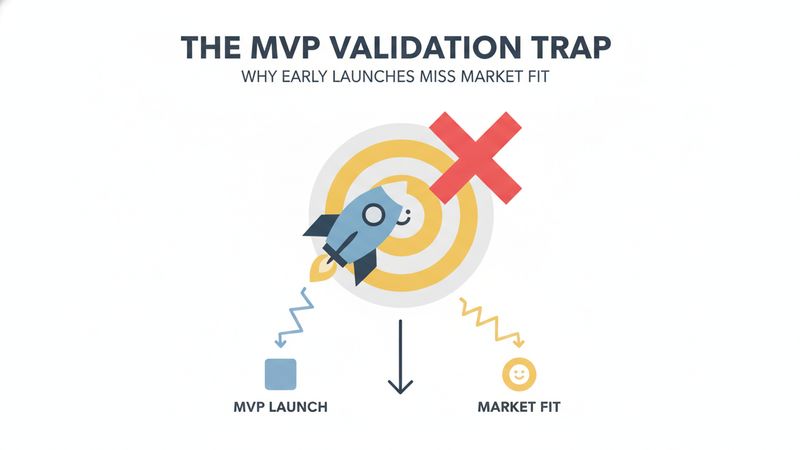
Over 40% of startups fail by mistaking polite feedback for true demand. Discover how structured MVP validation protects runway and drives real market traction.
Building a digital product has never been faster, yet achieving sustainable traction has rarely felt harder. According to venture failure research, over 42% of startups and new corporate ventures fail for a single underlying reason: building something the market does not actually need. While founders and product leaders often assume running out of cash is the cause of death, exhaustive post-mortems reveal that depleted capital is merely the final symptom. The true root cause is ineffective MVP validation—burning months of engineering budget chasing assumed customer demand that never materialized.
For Canadian tech leaders and enterprise innovation teams, capital efficiency is paramount. In competitive hubs like Toronto and the broader Waterloo-Toronto tech corridor, building a Minimum Viable Product (MVP) can no longer mean spending $80,000 to $150,000 over six months to launch an unproven prototype. Leaders must replace speculative development with disciplined validation velocity.
The Cost of False Signals: Why Polite Feedback Destroys Runway
Many early-stage product teams confuse early activity with genuine market validation. A spike in initial signups, enthusiastic comments from social networks, or polite nods during discovery interviews create a dangerous illusion of progress.
When teams mistake vanity metrics for product-market fit, they commit three costly errors:
- Premature Scaling: Pouring sales, marketing, and infrastructure budget into customer acquisition before the core product delivers undeniable, recurring value.
- The Feature-Addition Spiral: Reacting to lukewarm user retention by layering on more complexity, assuming the "next feature" will unlock user love.
- Building Before Testing: Writing tens of thousands of lines of custom code before validating whether users will change their established daily workflows to adopt the solution.
Consider a real-world scenario: A mid-size logistics company in Toronto set out to launch a specialized subcontractor dispatch portal. Convinced they needed a full-featured platform, leadership committed five months and over CAD $120,000 to build enterprise reporting, custom invoicing, and automated SMS dispatching. When the platform finally launched, dispatchers abandoned it within a week—they found the manual interface too rigid for urgent field changes. Had the team tested a streamlined two-feature workflow with ten active drivers first, they would have identified the usability friction in two weeks for a fraction of the cost.
Shifting From "Can We Build It?" to "Will They Rely on It?"
In modern software delivery, technical feasibility is rarely the bottleneck. Cloud platforms, modern frameworks, and rapid API integrations make nearly any concept buildable. The strategic question business decision-makers must ask is behavioral: Will target users actively pull this product into their operational workflow?
To de-risk capital and maximize runway, top-performing product teams apply structured validation frameworks:
1. Isolate the Core Riskiest Assumption
Before building full user flows, isolate the single critical hypothesis that must hold true for your business model to work. If your value proposition is reducing data entry time for procurement managers, test that specific micro-workflow before creating billing portals, user permission tiers, or automated reporting engines.
2. Measure Behavioral Proof, Not Opinions
User surveys and interview praise are unreliable predictors of software adoption. Focus instead on tangible behavioral commitments:
- Cohort Retention Curves: Does active product usage flatten into a stable baseline after 14 to 30 days, or does engagement decay toward zero?
- Workflow Replacement: Are users independently completing the key action daily without hands-on customer success intervention?
- Willingness to Pay or Commit: Are early pilot users willing to sign a letter of intent, prepay a discounted annual license, or allocate internal budget?
3. Deploy Minimum Viable Tests (MVTs) Before Heavy Code
A Minimum Viable Test answers a critical market question with the least engineering possible. Interactive clickable prototypes, concierge pilots, or single-workflow web applications provide fast customer feedback in days rather than quarters.
Structuring a Lean MVP Roadmap for Predictable ROI
For enterprise leaders and founders preparing a new digital initiative, adopting a structured launch process ensures engineering dollars directly compound business value:
- Phase 1: Problem Definition & Wireframe Validation (Weeks 1–2): Map the acute pain point, outline user journeys, and test interactive prototypes with target buyers.
- Phase 2: Focused MVP Build (Weeks 3–8): Develop only the critical feature set required to solve the primary problem, backed by robust cloud architecture and clean API foundations.
- Phase 3: Live Pilot Measurement (Weeks 9–12): Deploy to a targeted cohort, tracking retention, usage drop-offs, and qualitative friction points.
- Phase 4: Data-Driven Iteration: Make informed pivot or scale decisions grounded in verified user behavior before committing expansion capital.
Partnering for Rapid, High-Impact Validation
Navigating the path from initial concept to commercial traction requires balanced technical execution and commercial pragmatism. Building too little leaves users underwhelmed; building too much burns precious runway.
Based in Toronto, Arepitas Technologies Inc helps startups and corporate innovators design, build, and deploy validated MVPs that minimize capital waste and accelerate time-to-market. By combining lean product strategy, modern cloud development, and data-driven user tracking, we ensure every engineering investment directly tests and proves market value. Explore our tailored software development solutions on our services page to turn your product vision into validated market success.
Sources
Need help with startup & mvp?
Arepitas Technologies Inc helps companies in Toronto build software, AI features, and digital products that scale.
Book a Free ConsultationRelated Articles
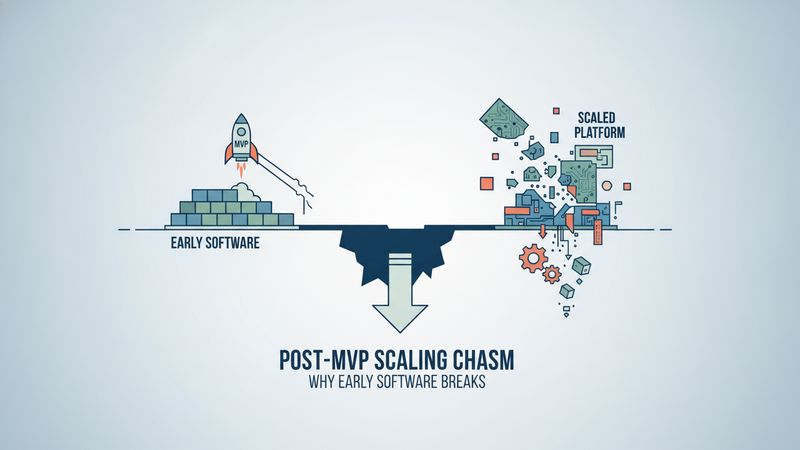
The Post-MVP Scaling Chasm: Why Early Software Breaks
Discover how growing startups can navigate post-MVP scaling without letting early technical shortcuts stall enterprise growth or burn critical venture runway.
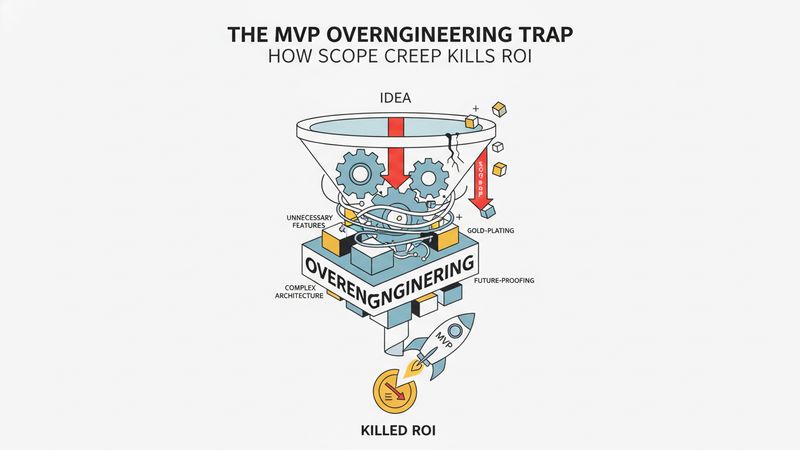
The MVP Overengineering Trap: How Scope Creep Kills ROI
Discover how overengineering and scope creep derail MVP development, drain early capital runway, and how Canadian founders can launch leaner products faster.
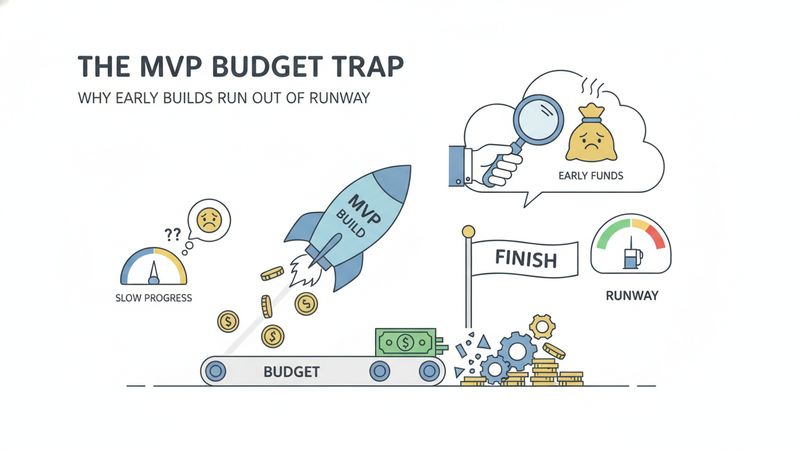
The MVP Budget Trap: Why Early Builds Run Out of Runway
Discover why bloated MVP scopes drain startup budgets before reaching market validation, and how Toronto leaders can build lean products that prove ROI fast.