The MVP Overengineering Trap: How Scope Creep Kills ROI
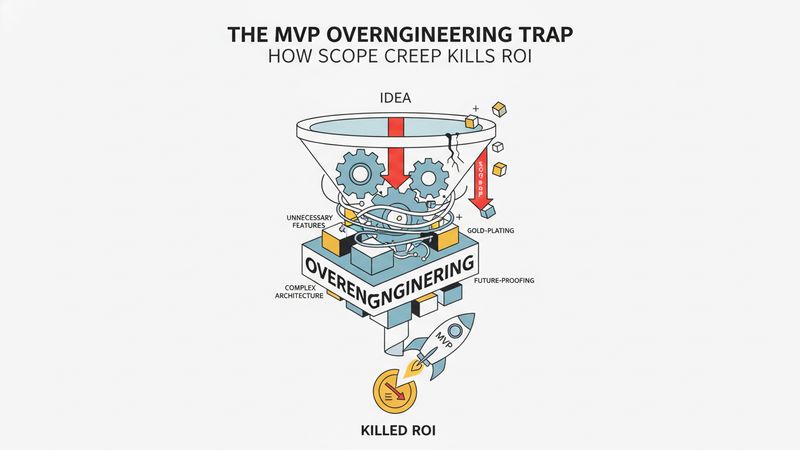
Discover how overengineering and scope creep derail MVP development, drain early capital runway, and how Canadian founders can launch leaner products faster.
In today’s high-stakes startup ecosystem, launching a Minimum Viable Product (MVP) is often celebrated as the golden gateway to market validation. Yet industry research shows that nearly 70% of MVPs fail to deliver meaningful business traction, with up to 42% failing because the build failed to address an authentic market need. For early-stage founders, startup operators, and corporate innovation leaders, the breakdown rarely stems from deficient coding skills or flawed market ambition. Instead, it traces directly back to the MVP overengineering trap—a costly strategic error where teams confuse building a functional learning vehicle with delivering a miniaturized version of a mature enterprise software suite.
When startups treat an initial release as a comprehensive demo rather than a focused experiment, development timelines routinely double from three months to nine months, operational capital evaporates, and product teams burn critical runway before securing verifiable user engagement. Understanding how to sidestep feature bloat and align technical architecture with lean validation principles is now the single biggest differentiator between sustainable commercial scale and an abandoned codebase.
The High Business Cost of Scope Creep in Early Builds
Every unnecessary feature added to a product roadmap carries hidden compounding costs. In software product management, the notorious 90/90 rule frequently derails engineering schedules: the first 90% of features consume 90% of the planned schedule, while the final 10% of polishing and edge-case testing consumes another 90% of the timeline.
For growing businesses, this dynamic creates direct balance-sheet consequences:
- Runway Depletion: Extended development cycles inflate developer payroll and cloud infrastructure costs without generating recurring customer revenue.
- Delayed Market Feedback: Spending six months perfecting automated billing or complex administrative panels delays the moment real customers interact with the primary value proposition.
- Architectural Tech Debt: Overbuilding before validating workflows locks companies into rigid monolithic or overly complex microservice designs that are expensive to refactor once real user feedback arrives.
- Loss of Team Focus: Engineers and product managers get bogged down maintaining secondary workflows rather than iterating on the core problem-solving engine.
Consider a real-world scenario from the Canadian innovation corridor: A mid-sized logistics technology venture in Toronto raised seed capital to automate local freight dispatching. Instead of releasing an MVP focused strictly on real-time load matching and SMS dispatch alerts, the leadership team spent five extra months building multi-tier permissions, customized analytics dashboards, and an automated supplier invoicing engine. By the time the software went live, the company had burned through 60% of its technical budget—only to realize during beta testing that dispatchers prioritized mobile chat response speed over analytical dashboards. The team had spent hundreds of thousands of dollars perfecting features their target buyers never utilized.
Shifting From Feature Accumulation to Hypothesis-Driven Development
To protect capital runway and de-risk the path to product-market fit, founders and technology executives must fundamentally redefine what "viable" means in software delivery. An MVP is not a showcase designed to impress stakeholders at conferences; it is an agile learning mechanism engineered to test your riskiest commercial assumptions with the least amount of custom code.
Strategic technology leaders apply rigorous scoping frameworks like MoSCoW (Must-have, Should-have, Could-have, Won't-have) or RICE scoring to filter out speculative functionality. If a capability does not directly prove whether a customer will engage with or pay for your core solution, it belongs in a post-launch sprint rather than the initial release.
The Anatomy of a Lean Validation Architecture
A resilient MVP strikes a careful balance between rapid execution and scalable architectural foundations:
- Single-Core Value Focus: Identify the single user problem that delivers 80% of the perceived product value, and build an uncompromising, intuitive user journey around it.
- Composable SaaS Foundations: Rather than building proprietary customer management, auth layers, or reporting engines from scratch, integrate proven third-party APIs to handle baseline operational utilities.
- Built-in Telemetry and Analytics: Embed instrumentation directly into critical user flows to monitor conversion, feature drop-off, and retention patterns from day one.
- Modular Architecture: Build modular backend services and clean data models that can easily scale or pivot when user feedback demands iterative pivots.
Practical Steps to Launch Faster and Protect Capital Runway
Transitioning from speculative development to a high-velocity MVP build requires disciplined product governance from the discovery phase through to launch day.
- Enforce Strict Scope Cutoff Lines: Establish fixed, time-boxed milestones (typically 8 to 12 weeks) rather than open-ended feature lists. When timelines tighten, ruthlessly cut secondary features rather than pushing back the launch date.
- Conduct Real-World Pre-Validation: Before assigning full-stack engineering sprints, validate demand using interactive prototypes, concierge workflows, or targeted customer interviews to eliminate speculative building.
- Budget for Post-Launch Iteration: A common oversight is exhausting 90% of development budgets on version 1.0. High-performing startups allocate at least 40% to 50% of their technical budget for post-launch pivots, performance enhancements, and user feedback integration.
- Partner With Pragmatic Product Engineers: Choose development partners who challenge feature bloat rather than blindly billing hours for superfluous complexity.
For Canadian enterprises and startups looking to accelerate product validation without budget overruns, working with an experienced technical consultancy makes all the difference. Arepitas Technologies Inc, based in Toronto, helps organizations navigate the full lifecycle of lean product delivery. Through specialized custom development and product advisory services, Arepitas partners with founders and innovation leaders to ruthlessly scope requirements, engineer scalable cloud-native architectures, and ship revenue-ready MVPs on time and within budget.
Conclusion: Build to Learn, Not Just to Ship
In early-stage software delivery, speed of learning beats volume of features every time. Founders and product executives who succeed do not build more code; they cut through noise, isolate critical business hypotheses, and release functional solutions that solve immediate client pain points. By abandoning the urge to overengineer and embracing a disciplined, data-backed MVP methodology, companies preserve capital, accelerate product-market fit, and establish a rock-solid foundation for long-term commercial scale.
Sources
Need help with startup & mvp?
Arepitas Technologies Inc helps companies in Toronto build software, AI features, and digital products that scale.
Book a Free ConsultationRelated Articles
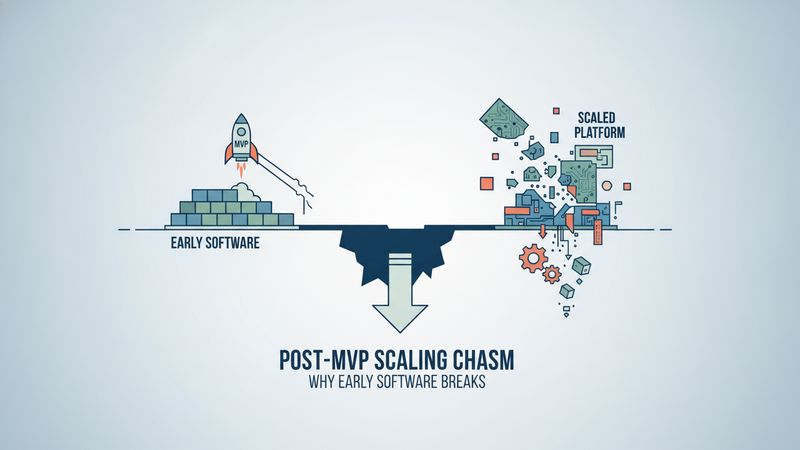
The Post-MVP Scaling Chasm: Why Early Software Breaks
Discover how growing startups can navigate post-MVP scaling without letting early technical shortcuts stall enterprise growth or burn critical venture runway.
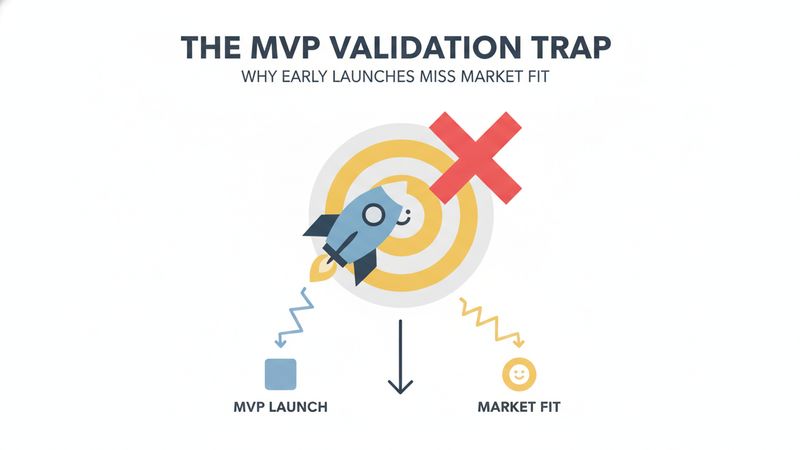
The MVP Validation Trap: Why Early Launches Miss Market Fit
Over 40% of startups fail by mistaking polite feedback for true demand. Discover how structured MVP validation protects runway and drives real market traction.
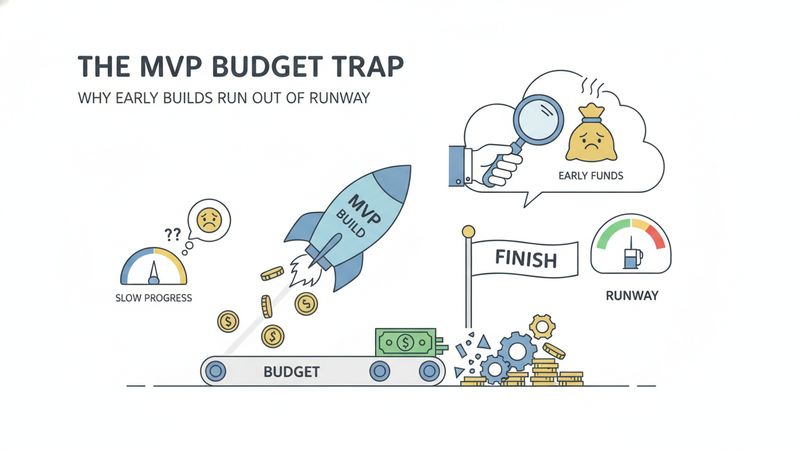
The MVP Budget Trap: Why Early Builds Run Out of Runway
Discover why bloated MVP scopes drain startup budgets before reaching market validation, and how Toronto leaders can build lean products that prove ROI fast.