The MVP Budget Trap: Why Early Builds Run Out of Runway
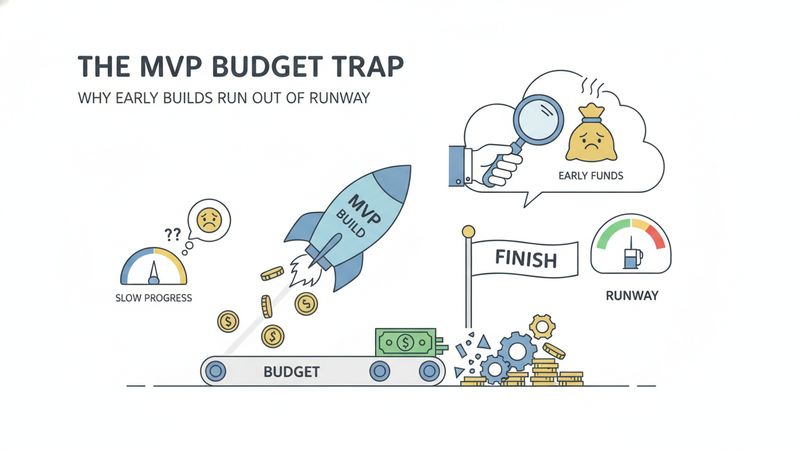
Discover why bloated MVP scopes drain startup budgets before reaching market validation, and how Toronto leaders can build lean products that prove ROI fast.
For early-stage founders and corporate innovation leaders alike, the journey from concept to market is fraught with financial risk. According to recent market analysis from CB Insights, running out of capital accounts for 70% of startup failures, while 43% collapse due to a lack of genuine market need. In most cases, the fatal flaw is not a flawed vision, but how companies approach MVP development. Instead of launching a focused Minimum Viable Product designed to test core assumptions, organizations often build an over-engineered version that burns capital, delays deployment, and misinterprets what early customers actually need.
In the tech corridors of Toronto, Waterloo, and across Canada, capital discipline has replaced growth-at-all-costs. Decision-makers who manage runway carefully understand that an MVP is not a stripped-down platform—it is a strategic experiment built to de-risk investment and prove ROI as quickly as possible.
The Real Cost of Scope Inflation in Early Product Builds
Industry benchmark data shows that the cost of building an MVP can range wildly from $15,000 to over $150,000. What drives this massive variance is rarely the underlying technical stack; it is the discipline of product scoping.
When product teams lack a strict framework for feature prioritization, MVP builds quietly bloat into pseudo-"Version 1.0" products. A timeline intended for 6 to 8 weeks stretches into 6 months, and initial budgets triple. By the time the product reaches user hands, two destructive scenarios unfold:
- Exhausted Validation Budgets: Capital that should have been allocated to customer acquisition, onboarding analysis, and post-launch iteration is consumed entirely by upfront engineering.
- Building the Wrong Solutions: Adding tertiary features—such as intricate reporting dashboards, multi-tier permissions, and custom billing automation—distorts real user feedback, making it harder to identify the true value proposition.
- Compounding Technical Friction: Early architectures that try to support every theoretical future use case end up rigid, making rapid pivots expensive and slow.
Consider a mid-size supply chain firm in the Greater Toronto Area seeking to modernize client intake. Instead of validating a single, frictionless portal workflow, leadership expanded the scope to include real-time IoT shipment telematics and predictive fleet scheduling. Four months and $120,000 later, user feedback revealed that dispatchers simply wanted a clean mobile confirmation interface. The bloated architecture had consumed the budget before solving the primary operational bottleneck.
Shifting from Feature Lists to Value Hypotheses
Winning businesses approach product creation with a risk-mitigation mindset. To avoid the MVP budget trap, technology leaders must shift from building feature lists to testing measurable business hypotheses.
1. Identify the Single Core Workflow
An effective MVP focuses on solving one painful friction point exceptionally well. Every proposed feature must pass a single governance filter: Does this directly prove whether our target audience will adopt and pay for this solution? If an administrative capability or automated integration can be handled manually during the pilot stage, it should not be coded into the first sprint.
2. Prioritize Speed to Feedback Over Architectural Perfection
While security, privacy compliance (such as PIPEDA in Canada), and data governance are non-negotiable, building for millions of concurrent users on day one is an unnecessary cost center. High-performing teams leverage modern cloud building blocks, proven frameworks, and pre-built authentication systems to launch within 4 to 6 weeks. The primary objective is establishing an active feedback loop with real operators.
3. Reserve Runway for Post-Launch Adaptation
Strategic budgeting dictates that the initial build should consume no more than 50% to 60% of the allocated innovation budget. The remaining funds must be reserved for iterative development based on qualitative usage analytics, bug triage, and rapid workflow adjustments identified during the initial pilot phase.
The Partner-Build Advantage for Mid-Market Enterprises
For growing Canadian enterprises looking to test digital products or internal tools without ballooning operational payroll, building an in-house engineering team from scratch often introduces unnecessary friction. With senior engineering compensation averaging six figures before onboarding and infrastructure costs, hiring delays can stall product launches by quarters.
This reality is why leaders increasingly turn to specialized engineering partners. A focused partner brings established deployment pipelines, battle-tested UI/UX patterns, and architectural expertise to deliver a functional MVP in weeks rather than months. This model gives founders and operations directors the agility to validate product-market fit without taking on long-term overhead.
Building Lean with Arepitas Technologies Inc
Navigating early-stage product development requires a balance of speed, architectural foresight, and budget discipline. Arepitas Technologies Inc, based in Toronto, works closely with founders, operational directors, and enterprise teams across Canada to translate high-stakes concepts into functional, scalable software.
Whether you are launching a customer-facing digital product, validating a new business line, or modernizing an operational process, explore our tailored software engineering and MVP delivery services to build lean, test fast, and protect your capital.
Sources
Need help with startup & mvp?
Arepitas Technologies Inc helps companies in Toronto build software, AI features, and digital products that scale.
Book a Free ConsultationRelated Articles
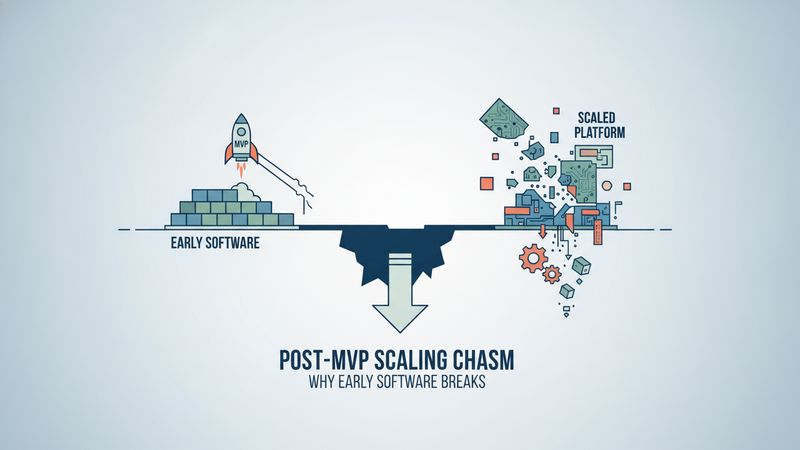
The Post-MVP Scaling Chasm: Why Early Software Breaks
Discover how growing startups can navigate post-MVP scaling without letting early technical shortcuts stall enterprise growth or burn critical venture runway.
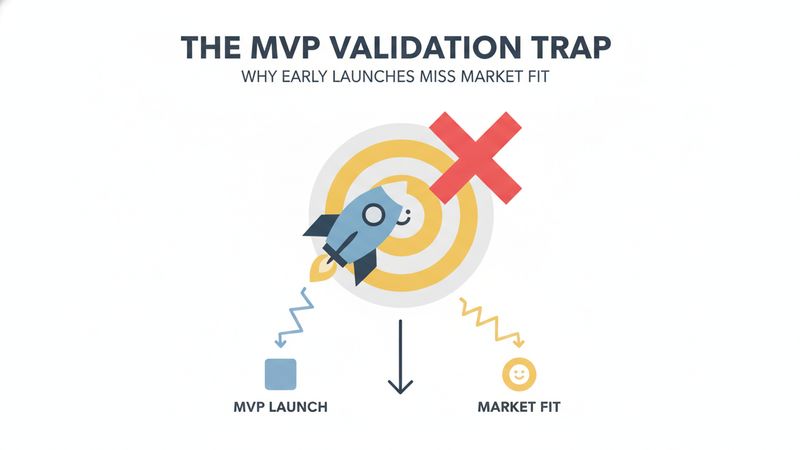
The MVP Validation Trap: Why Early Launches Miss Market Fit
Over 40% of startups fail by mistaking polite feedback for true demand. Discover how structured MVP validation protects runway and drives real market traction.
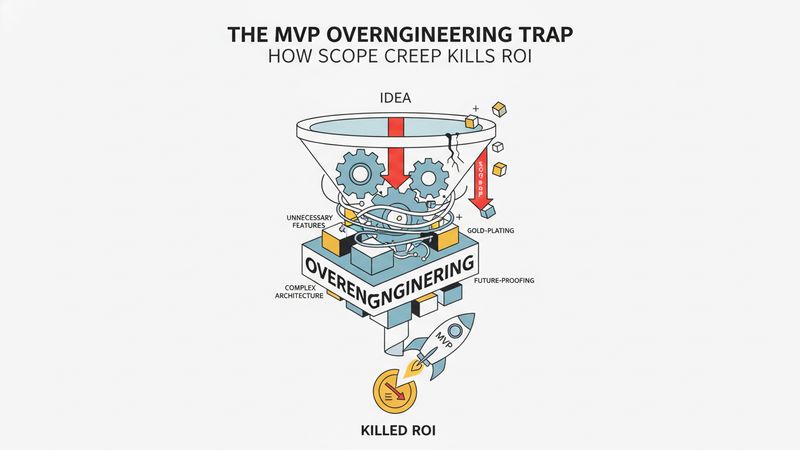
The MVP Overengineering Trap: How Scope Creep Kills ROI
Discover how overengineering and scope creep derail MVP development, drain early capital runway, and how Canadian founders can launch leaner products faster.