The Mobile Conversion Trap: Reclaiming Lost Digital ROI
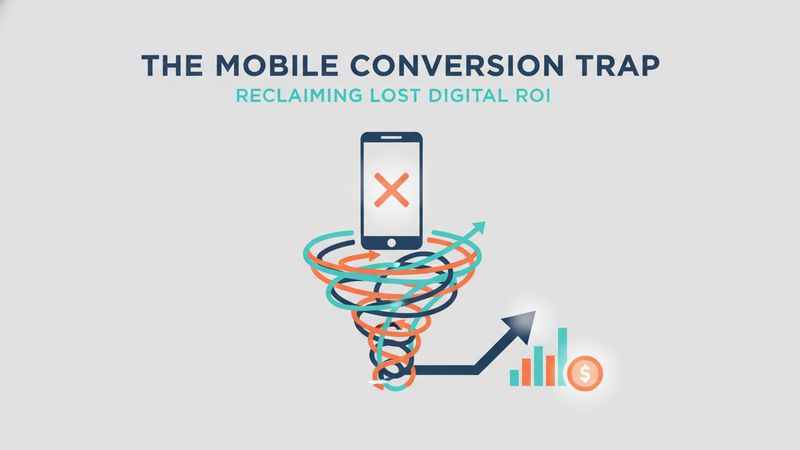
Explore why fragmented web and mobile app strategies drain budgets and how Toronto enterprises can eliminate checkout friction to recapture digital revenue.
For mid-market executives, web and mobile traffic numbers have never looked healthier. Across B2B portals, commercial storefronts, and client platforms, mobile devices now account for over 70% of total incoming visits. Yet behind these traffic gains lies a persistent financial leak: the mobile conversion trap. While mobile visitors dominate top-of-funnel traffic, they convert at rates roughly 35% to 50% lower than desktop users. Compounding the problem, engineering teams frequently manage two or three siloed codebases—web, iOS, and Android—burning through 15% to 20% of their initial build budgets every single year just on routine maintenance and operating system updates.
When executive teams attempt to fix this issue by deploying standalone native apps, they often find that customer acquisition costs escalate while daily engagement stagnates. In an economy where capital efficiency is paramount, Canadian business leaders cannot afford to let digital customer journeys hemorrhage revenue due to slow load times, bloated app maintenance, and checkout friction.
The Real Cost of Multi-Platform Fragmentation
Many organizations fall into the multi-platform trap during early growth phases. The standard playbook was simple: launch a desktop web portal, commission a separate iOS app, and build an Android counterpart. However, this fragmented approach quietly erodes software ROI over time.
- Compounding Maintenance Overheads: Managing separate codebases means every business logic update, UI adjustment, and security patch must be developed and tested three separate times. Annual maintenance for native mobile apps consistently costs 15% to 20% of original development budgets, climbing to nearly 50% in the first stabilization year.
- App Store Gatekeeping and Friction: Native apps require users to leave the browser, navigate an app marketplace, download a large binary, and grant extensive permissions. Industry benchmarks indicate that up to 85% of mobile users abandon apps that consume excess device storage or introduce installation delays.
- The High Price of Latency: According to digital experience benchmark studies, more than 35% of all web sessions are disrupted by user frustration, including rage clicks and page lag. In mobile environments, even a 0.1-second increase in page load time can reduce conversion rates by more than 8%.
When businesses divide their engineering payroll across separate native frameworks, velocity stalls. New feature rollouts that should take weeks stretch into multi-quarter deployment cycles, delaying commercial time-to-market and frustrating end users.
Scenario: How an Ontario Distributor Overcame Digital Channel Friction
A mid-sized industrial equipment supplier based in the Greater Toronto Area operated a legacy B2B catalog on the web alongside separate native ordering apps for field contractors. Despite substantial digital adoption, field sales and recurring client orders were declining quarter-over-quarter.
An audit of their digital touchpoints revealed critical points of friction:
- High Checkout Drop-Off: Field buyers navigating the mobile web suffered through desktop-oriented tables and slow-loading checkout pages, leading to a 72% mobile cart abandonment rate.
- Version Desynchronization: Pricing rules and inventory levels updated in the web ERP took days to reflect on the native mobile apps due to separate deployment pipelines and app store approval queues.
- Engineering Resource Drain: Over 40% of the in-house developer team was dedicated strictly to debugging platform-specific crashes across varying iOS and Android OS updates instead of developing revenue-generating capabilities.
Rather than pouring more capital into rebuilding the native apps, the company unified its platform under a modern, responsive Progressive Web App (PWA) architecture. By consolidating to a single codebase with instant browser access, offline functionality, and integrated one-tap payments, the company cut development cycle times by 60% and lifted mobile checkout completion by 28% within four months.
Strategic Steps to Close the Mobile Conversion Gap
To restore engineering momentum and capture lost digital revenue, business leaders should take four actionable steps:
1. Evaluate Unified Web Architectures Over Siloed Native Builds
Unless your application requires specialized device hardware integrations, modern web architectures such as Progressive Web Apps (PWAs) deliver up to 30% to 50% lower initial build costs and drastically reduced long-term maintenance overhead. A unified codebase ensures that business logic, product listings, and security policies deploy instantly across all mobile and desktop browsers.
2. Audit Core Web Performance and User Journey Friction
Implement real-user monitoring (RUM) to track rage clicks, layout shifts, and mobile load times. Optimizing Core Web Vitals—compressing payloads, implementing edge caching, and streamlining DOM rendering—directly improves conversion velocity and organic search visibility.
3. Streamline Mobile Authentication and Payment Workflows
Eliminate unnecessary checkout fields and multi-step forms on mobile devices. Integrating native browser payment protocols (such as Apple Pay and Google Pay) and passkey authentication removes traditional checkout friction, driving significant lifts in mobile transaction completion.
4. Align Digital Modernization with Commercial Objectives
Ensure technology investments are measured against business KPIs—such as cost per acquisition, transaction completion velocity, and maintenance-to-revenue ratios—rather than vanity metrics like raw app downloads.
Modernizing Your Digital Platform with Arepitas Technologies
Modernizing your mobile and web footprint does not require complex multi-year overhauls. At Arepitas Technologies Inc, we partner with business leaders across Toronto and Canada to replace fragile, fragmented digital systems with scalable, high-performance web applications.
Whether you need to streamline client portals, eliminate mobile checkout bottlenecks, or consolidate disjointed native apps into a unified architecture, explore our full range of tailored solutions on our services page to start maximizing your digital return on investment.
References
- Digital Applied: Conversion Rate Benchmarks 2026: Industry and Channel Data
- Contentsquare: How Frustration Impacts Digital Experiences in 2026
- SFAI Labs: Why Mobile Apps Cost More Than Web Apps: A Technical Breakdown
Sources
Need help with mobile & web development?
Arepitas Technologies Inc helps companies in Toronto build software, AI features, and digital products that scale.
Book a Free ConsultationRelated Articles
The Dual-Codebase Drain: Slashing Mobile App Costs
Maintaining separate iOS and Android apps doubles mobile app development cost without doubling value. Here is how leaders cut mobile TCO with unified stacks.
The Frontline App Disconnect: Fixing Field Service Margins
Siloed field operations drain profitability. Learn how mobile workflow modernization connects frontline teams, eliminates delays, and recovers margins.
B2B Portal Modernization: Bridging the Self-Service Gap
Outdated customer portals cost Canadian enterprises millions in manual support. Learn why B2B portal modernization drives retention and operational efficiency.