The Dual-Codebase Drain: Slashing Mobile App Costs
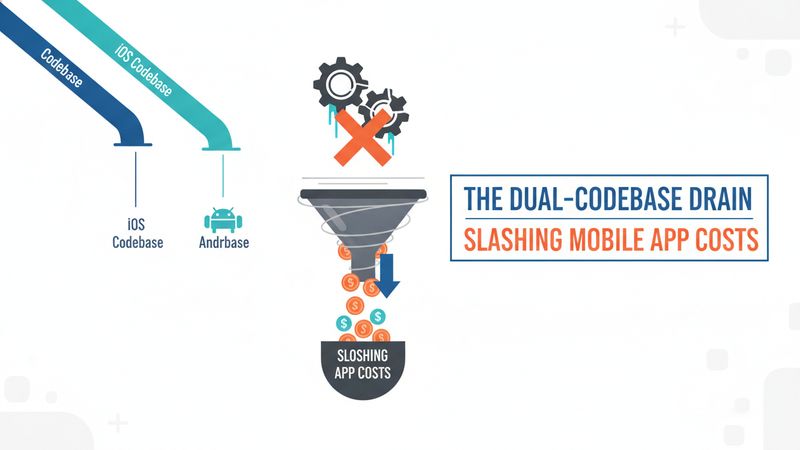
Maintaining separate iOS and Android apps doubles mobile app development cost without doubling value. Here is how leaders cut mobile TCO with unified stacks.
For executive decision-makers, managing mobile app development cost across dual operating systems has become an unsustainable operational liability. Corporate technology budgets are tighter than ever, yet mid-market companies in Ontario and across Canada routinely allocate between $150,000 and $250,000 upfront just to launch basic client-facing applications across iOS and Android. The issue is not the technology itself, but the organizational friction of maintaining two isolated codebases—Swift for Apple and Kotlin for Google—each demanding dedicated engineers, disparate release schedules, and redundant quality assurance pipelines.
When every feature request must be engineered twice, roadmap velocity slows to a crawl. Product managers find themselves arbitrating version parity disputes, customer support teams field tickets from uneven releases, and executives end up funding parallel development teams without gaining a single incremental user. In an economy where digital speed dictates market share, continuing to absorb this dual-codebase overhead without clear hardware justification drains capital that should be driving core business growth.
The Real Financial Impact of Dual Native Codebases
Many organizations fall into the native trap by default, assuming that top-tier user experiences require separate platform-specific builds. In specialized domains—such as graphic-intensive 3D mobile games or complex Bluetooth hardware integrations—native builds remain justified. However, for standard transactional products like customer portals, inventory tracking tools, scheduling platforms, and internal logistics engines, dual native architecture is an expensive overengineering trap.
According to recent cost benchmarks from Authect, building separate native iOS and Android applications commands an average initial build cost of $156,000, compared to $87,000 for unified cross-platform solutions—representing a 75% to 80% premium for dual native architecture. Further analysis by LowCode Agency demonstrates that cross-platform frameworks routinely compress overall build outlays by 30% to 40% through shared logic and smaller, unified development teams.
The financial friction extends well past product launch:
- Compounded Maintenance Overheads: Enterprise maintenance contracts generally add 15% to 25% of initial build costs annually. When managing dual native apps, businesses carry double the maintenance surface, paying twice for OS upgrades, third-party library patches, and security compliances.
- Fragmented Customer Experience: Feature parity drifts when one team moves faster than the other. Discrepancies between iOS and Android versions create internal friction and confuse end users.
- Inflated Talent Allocation: Hiring and retaining separate Swift and Kotlin developers in competitive tech hubs like Toronto and Vancouver commands a premium, driving engineering payrolls higher without delivering extra customer value.
Executive Decision Framework: Choosing the Right Application Stack
Before greenlighting a capital expenditure for mobile and web development, business leaders must assess real technical needs against business targets. The following framework simplifies the decision:
1. High-Performance Native (Swift & Kotlin)
- When to choose: You require continuous background processing, high-frequency Bluetooth or IoT device connectivity, sub-millisecond graphic rendering, or proprietary biometric sensors.
- Expected investment: $120,000 to $250,000+ for initial dual-platform deployment.
- Timeline: 6 to 9 months per platform.
2. Modern Cross-Platform (React Native & Flutter)
- When to choose: Your product centers around database operations, API consumption, customer workflows, account management, commerce transactions, or field reporting. Cross-platform delivers near-native performance while sharing up to 90% of business logic across iOS and Android.
- Expected investment: $50,000 to $120,000 for simultaneous two-platform launch.
- Timeline: 3 to 6 months.
3. Progressive Web Applications (PWAs) & Responsive Web Portals
- When to choose: You need rapid distribution without App Store approval delays, or your user base predominantly accesses the system from desktop workstations alongside mobile browsers. PWAs eliminate the 15% to 30% app store ecosystem taxes entirely while cutting 3-year ownership costs significantly.
- Expected investment: $25,000 to $65,000.
- Timeline: 2 to 4 months.
Modernizing Your Product Delivery: Practical Next Steps
Transitioning away from fragmented, redundant development pipelines requires strategic execution rather than a disruptive rip-and-replace approach. CTOs and product directors should consider the following phased roadmap:
- Audit Feature Parity and Usage: Analyze user telemetry to determine which mobile capabilities drive authentic engagement. If 95% of active users rely solely on basic transactions, document views, and messaging, your business is paying for native device overhead that yields negligible ROI.
- Unify the API and Data Layer: Ensure that all mobile touchpoints interact with a decoupled, modular backend API. Standardizing backend services ensures that future web and mobile interfaces consume identical business rules, lowering ongoing QA complexity.
- Consolidate on an Iterative Framework: If rebuilding from scratch is impractical, adopt hybrid or cross-platform modules within your existing application shell. Major global platforms have successfully reduced operational spend by embedding unified web and cross-platform views into native shells over consecutive quarters.
- Tie Technology Choices to Business KPIs: Frame every architecture debate around Total Cost of Ownership (TCO), speed to market, and developer velocity rather than engineering preferences.
Partnering with Development Experts to Maximize Return
For growing businesses and mid-market organizations across Canada, building internal teams for multiple disparate platforms introduces hiring delays and ongoing payroll bloat. Selecting an experienced software engineering partner enables organizations to rapidly design, validate, and launch cross-platform applications without incurring legacy technical debt.
At Arepitas Technologies Inc, our Toronto-based engineering consultants help companies eliminate architectural waste, modernize legacy web applications, and launch resilient cross-platform mobile products built for measurable ROI. Whether you are re-evaluating an expensive dual native roadmap, streamlining an existing web portal, or building an agile cross-platform product from the ground up, explore our tailored development services to find the right technical strategy for your enterprise, or reach out directly through our contact page to schedule a technical architecture assessment.
Sources
Need help with mobile & web development?
Arepitas Technologies Inc helps companies in Toronto build software, AI features, and digital products that scale.
Book a Free ConsultationRelated Articles
The Mobile Conversion Trap: Reclaiming Lost Digital ROI
Explore why fragmented web and mobile app strategies drain budgets and how Toronto enterprises can eliminate checkout friction to recapture digital revenue.
The Frontline App Disconnect: Fixing Field Service Margins
Siloed field operations drain profitability. Learn how mobile workflow modernization connects frontline teams, eliminates delays, and recovers margins.
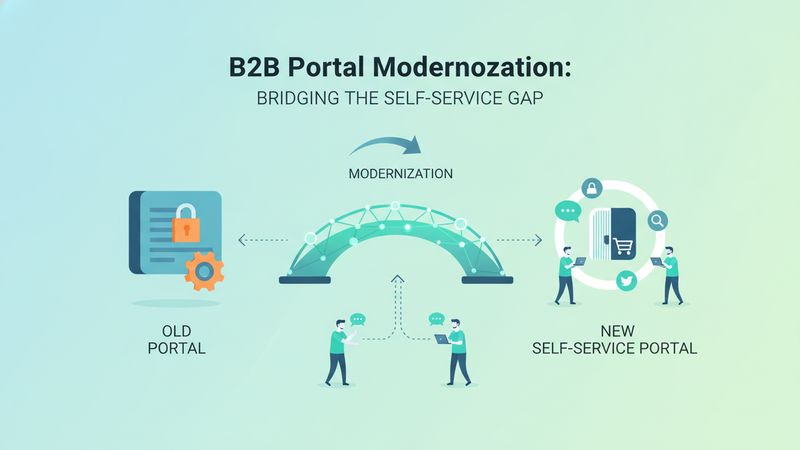
B2B Portal Modernization: Bridging the Self-Service Gap
Outdated customer portals cost Canadian enterprises millions in manual support. Learn why B2B portal modernization drives retention and operational efficiency.