B2B Portal Modernization: Bridging the Self-Service Gap
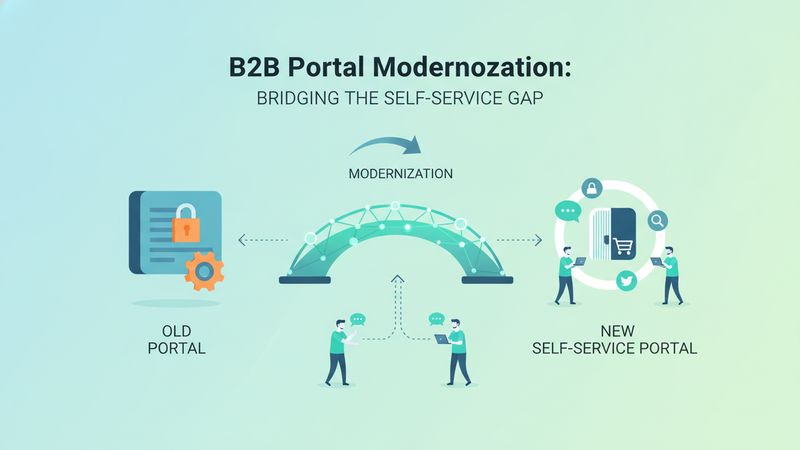
Outdated customer portals cost Canadian enterprises millions in manual support. Learn why B2B portal modernization drives retention and operational efficiency.
For mid-market and enterprise business leaders, the definition of exceptional client service has fundamentally transformed. Recent market research reveals that 84% of business buyers now expect their online digital experience—including negotiated contract pricing, real-time inventory visibility, and complete account histories—to match the context and speed they receive from a dedicated account representative. Yet, across Canada, hundreds of growing firms still rely on password-protected legacy extranets or basic forms that force high-value clients to pick up the phone or email purchase orders back and forth. Embracing strategic B2B portal modernization is no longer just a digital facelift; it is an operational imperative that directly impacts bottom-line retention, employee bandwidth, and margin protection.
When customer-facing web platforms fail to communicate with backend databases, the cost is rarely isolated to the IT budget. Instead, it ripples across every department, turning simple transaction requests into expensive, multi-day coordination exercises between sales, operations, and finance teams.
The Real Cost of Outdated Client Portals
Many legacy web portals operating today were designed as static product catalogs or rudimentary ordering pages. As businesses scaled, diversified their product lines, and introduced complex contract structures, these aging portals became operational bottlenecks rather than efficiency drivers.
Organizations running fragmented client portals regularly suffer from three major business drains:
- Compounded Operational Overhead: When a portal cannot pull dynamic tier pricing or live inventory from the ERP, account managers spend hours manually validating quotes, checking warehouse stock, and keying data into multiple systems.
- Increased Order Velocity Friction: Modern procurement teams operate under tight deadlines. If placing a complex reorder takes two days of manual back-and-forth instead of two minutes inside a self-service portal, clients will migrate to competitors offering modern digital tooling.
- Support Team Burnout and Error Rates: Manual entry across disconnected systems introduces recurring invoicing mistakes, fulfillment delays, and unnecessary customer support tickets, consuming up to 30% of administrative bandwidth.
According to national enterprise studies by CGI, nearly half of Canadian businesses report that legacy system dependencies significantly challenge their digital adoption strategies, with 85% planning to modernize core business applications over the next 24 months to keep pace with demand.
Traditional Extranet (Friction)          Modernized B2B Portal (Automated)
[Client PDF / Email Request]             [Client Authenticated Self-Service]
             │                                            │
[Manual Sales Rep Verification]          [Real-Time ERP / Inventory Sync]
             │                                            │
[Manual Inventory / Finance Check]       [Instant Dynamic Contract Pricing]
             │                                            │
[3-5 Business Days to Process]           [Automated Fulfillment in Minutes]
Real-World Scenario: The Ontario Industrial Supply Bottleneck
Consider a mid-size industrial equipment supplier in the Greater Toronto Area (GTA) managing relationships with over 300 commercial contractors. For years, the company operated a custom web portal built in 2014. While clients could technically log in, the system lacked real-time integration with their internal inventory and accounting software.
As a result, contractor accounts were forced to download PDF price schedules, cross-reference custom volume discounts manually, and email purchase orders to account reps for order confirmation. During seasonal demand surges, the supplier's six-person customer service team spent over 60% of their day answering basic inquiries: "Is this part in stock?", "What is my contracted volume rate?", and "Where is my shipment?"
By undertaking a comprehensive B2B portal modernization initiative, the company replaced its static interface with an API-driven, role-based web application. The new system securely integrated with their core ERP, enabling contractors to instantly generate binding quotes, inspect live warehouse quantities across Ontario distribution hubs, and track delivery milestones autonomously. Within four months of launch, order processing times dropped from 48 hours to under 15 minutes, customer support call volumes decreased by 42%, and client retention among top-tier accounts reached 98%.
Key Architecture Pillars of a Modern B2B Web Portal
Modernizing a client-facing web application does not mean undertaking a multi-year, high-risk overhaul. Instead, successful engineering teams focus on three essential functional layers:
1. Integration-First ERP and CRM Connectivity
A high-impact web portal must act as an intelligent gateway to your single source of truth. By utilizing robust RESTful APIs and event-driven webhooks, modern web portals synchronize order statuses, contract agreements, and inventory thresholds seamlessly without corrupting legacy core records.
2. Granular Role-Based Access Controls (RBAC)
B2B purchasing involves multiple internal stakeholders—from procurement clerks submitting purchase orders to finance directors approving invoices. Modern web applications require flexible authentication and permission tiers that mirror enterprise organizational hierarchies, complete with Single Sign-On (SSO) and SOC 2-compliant data segregation.
3. Automated Self-Service Workflows
High-value portals automate complex transactional logic directly within the user interface. This includes dynamic Request for Quote (RFQ) builders, automated approval routings, self-service recurring billing, and instant dispute management.
Practical Steps for Business Leaders
If your organization is planning a portal modernization roadmap this year, prioritize these strategic actions:
- Audit Repetitive Administrative Tasks: Identify the top five questions or manual tasks your support and sales operations handle daily. These workflows should form the core feature set of your initial rollout.
- Decouple the Front-End from Backend Monoliths: Avoid rewiring your entire core backend at once. Build an API orchestration layer that lets you deploy a fast, modern web front-end while preserving your core databases.
- Deliver a Focused Minimum Viable Product (MVP): Rather than waiting 18 months for a monolithic deployment, launch a targeted 10-to-12-week MVP addressing a high-friction client segment, then iterate based on direct feedback.
Accelerate Your Digital Transformation
Building a secure, scalable, and integration-heavy web portal requires a partner who understands both modern cloud architectures and the unique operational requirements of Canadian businesses.
Arepitas Technologies Inc, based in Toronto, specializes in custom web application development, legacy system modernization, and enterprise cloud integrations. Whether you need to replace an obsolete customer extranet or unify fragmented ERP data into a responsive client portal, explore our custom software and modernization services to turn your digital touchpoints into long-term competitive advantages.
Conclusion
Customer loyalty in the enterprise sector is no longer won solely through personal relationships; it is retained through speed, data accuracy, and effortless digital self-service. By modernizing legacy customer portals into secure, integrated web platforms, business leaders eliminate administrative waste, empower their workforce, and provide the frictionless experience today's market demands.
Sources
Need help with mobile & web development?
Arepitas Technologies Inc helps companies in Toronto build software, AI features, and digital products that scale.
Book a Free ConsultationRelated Articles
The Dual-Codebase Drain: Slashing Mobile App Costs
Maintaining separate iOS and Android apps doubles mobile app development cost without doubling value. Here is how leaders cut mobile TCO with unified stacks.
The Mobile Conversion Trap: Reclaiming Lost Digital ROI
Explore why fragmented web and mobile app strategies drain budgets and how Toronto enterprises can eliminate checkout friction to recapture digital revenue.
The Frontline App Disconnect: Fixing Field Service Margins
Siloed field operations drain profitability. Learn how mobile workflow modernization connects frontline teams, eliminates delays, and recovers margins.