Legacy Software Migration: The Executive Buyer's Guide
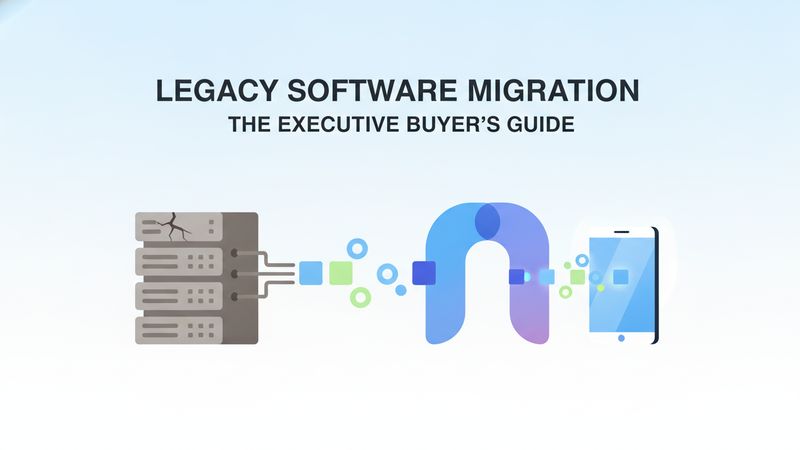
Planning a legacy software migration? Here is a practical framework to evaluate budgets, eliminate cutover risk, and protect your margins without downtime.
For executive leaders, few technical initiatives carry as much operational dread as a legacy system overhaul. Decades of institutional knowledge, patched business logic, and bespoke data structures often live inside monolithic systems that no single engineer fully understands. Yet, postponing a legacy software migration is no longer a neutral operational choice—it is a compounding balance-sheet liability. According to recent research on enterprise application health, legacy systems consume between 58% and 74% of corporate IT budgets merely on routine maintenance and incident triage, leaving minimal capital for product innovation or AI initiatives.
When maintenance costs soar while release cycles grind to weeks instead of hours, executive teams face a pivotal decision: continue subsidizing legacy fragility or initiate a modernization program. This buyer's guide breaks down the true business economics, evaluation frameworks, and budgeting benchmarks leaders need to navigate a successful migration without jeopardizing business continuity.
The True Financial Drag of Inaction
Many leadership teams hesitate to modernize because the incumbent software "still works." It processes orders, reconciles invoices, and powers core operations. However, operational stability on the surface frequently masks deep economic friction below:
- The Engineering Capacity Drain: When engineering teams dedicate more than 60% of their sprints to keeping fragile codebases functional, development velocity drops precipitously. Feature requests that should take days require multi-week regression testing cycles.
- The Talent Cliff: As specialized developers familiar with 15-year-old frameworks retire or move on, finding talent to maintain proprietary architectures becomes prohibitively expensive. Organizations find themselves reliant on high-cost niche contractors just to patch security vulnerabilities.
- Compliance and Cyber Risk Exposure: Legacy stacks rarely adhere to contemporary security standards. In Canada, where heightened scrutiny under PIPEDA and provincial privacy regulations mandates rigorous data protection, unsupported frameworks present significant regulatory and liability exposure.
- The Blocked AI Roadmap: Enterprise leaders cannot deploy autonomous workflow agents or retrieval-augmented generation (RAG) models on top of fragmented, relational databases trapped in on-premises silos. A delayed migration delays an entire automation roadmap.
For mid-sized and scaling enterprises across Ontario and the greater Canadian market—from logistics operators in Mississauga to financial service firms in downtown Toronto—these bottlenecks directly compress operating margins and erode competitive positioning.
Modernization Strategies: A Decision Framework
Executive failure in modernization rarely stems from poor programming; it stems from choosing the wrong migration strategy. Complete "big-bang" rewrites fail at an estimated rate of 70% to 79% because they attempt to replace complex, interdependent systems in a single risky cutover. Instead, leaders should match their migration strategy to operational risk tolerance.
1. The Strangler Fig Pattern (Incremental Replacement)
- How it works: Rather than rebuilding the system all at once, engineers place a modern API gateway around the legacy core, carving out bounded business services one module at a time.
- Best for: Core operational systems, high-transaction platforms, and ERPs where downtime or data loss would shut down revenue-generating workflows.
- ROI Profile: Moderate upfront cost, low cutover risk, and immediate time-to-value as each modernized module deploys independently.
2. Targeted Refactoring & Cloud Replatforming
- How it works: Core business logic is preserved, but outdated runtime environments, database layers, and deployment scripts are updated to cloud-native managed services.
- Best for: Applications with sound business logic that suffer from performance bottlenecks, high server hosting costs, or scaling limits.
- ROI Profile: Fastest timeline, lower engineering overhead, and a direct 20% to 35% reduction in infrastructure operating expenditures.
3. Complete Re-Architecture
- How it works: Full decommissioning of the legacy platform in favour of a newly built, cloud-native architecture.
- Best for: Outdated software built on obsolete languages where the underlying data schemas and user workflows no longer match business realities.
- ROI Profile: Highest initial investment, requiring rigorous stage-gate approvals and domain-driven architectural planning to prevent scope creep.
Budget and Timeline Benchmarks for 2026
When budgeting a software migration, leaders must account for discovery, data pipeline engineering, regression testing, and post-launch stabilization. Industry benchmarks reveal the following typical investment brackets:
- Departmental Workflow Applications ($40,000 – $95,000 CAD): Targeted modernization of isolated tools or reporting hubs. Timelines span 8 to 14 weeks, focusing on database migration, UI upgrades, and cloud deployment.
- Core Mid-Market Operations Systems ($120,000 – $350,000 CAD): Comprehensive modernization of proprietary order-management, supply chain, or client portals. Executed in incremental milestones over 4 to 9 months using strangler patterns.
- Enterprise-Scale Platforms ($400,000 – $1,200,000+ CAD): Multi-system decommissioning across distributed environments, core banking modules, or regulatory records. Timelines span 10 to 18 months with dedicated cutover sandboxes.
In properly scoped projects, organizations achieve break-even within 18 to 28 months through lower server licensing fees, reduced maintenance overhead, and recovered engineering velocity.
Vetting a Migration Development Partner
Because internal product teams are often occupied maintaining ongoing revenue operations, partnering with an experienced software development agency is standard practice. However, evaluating a migration partner requires different criteria than hiring an early-stage MVP agency. Before signing an engagement, ask these five critical questions:
- How do you map undocumented business logic? Avoid partners that jump straight to coding. A credible partner conducts deep code auditing, database profiling, and user journey discovery before proposing an architecture.
- What is your cutover and rollback protocol? If a migration partner cannot demonstrate an active dual-write or automated rollback mechanism for go-live day, your operations are at risk.
- How do you handle data integrity and validation? In complex migrations, data pipelines and schema mapping represent half the project risk. Demand proven reconciliation scripts and data validation tests.
- Will this system support modern AI integrations? Ensure the modernized architecture uses clean API contracts, vector-compatible data pipelines, and scalable cloud structures ready for future automation.
- What is the post-launch stabilization plan? Quality teams include dedicated post-cutover monitoring to ensure SLA performance, zero latency spikes, and smooth user adoption.
For companies seeking technical guidance without bureaucratic overhead, partnering with a regional engineering firm provides critical strategic alignment. Toronto-based teams like Arepitas Technologies Inc specialize in assessing complex legacy platforms, establishing clear ROI milestones, and executing phased cloud and software migrations that protect core business margins.
The Strategic Takeaway
A legacy software migration is not an engineering vanity project; it is a capital investment designed to safeguard business continuity, liberate engineering resources, and position your company for scalable growth. Leaders who evaluate their systems through structured risk frameworks, establish milestone-based budgets, and select experienced delivery partners turn technical debt into an enduring competitive advantage.
Explore our tailored software migration and architecture services at /services to plan your modernization roadmap.
Sources
Need help with software migrations?
Arepitas Technologies Inc helps companies in Toronto build software, AI features, and digital products that scale.
Book a Free ConsultationRelated Articles
The Data Migration Trap: Stopping Costly Cutover Delays
With 83% of data migrations exceeding budgets or timelines, business leaders must ditch big-bang cutovers for pragmatic, phased modernizations that protect ROI.
The Legacy Database Drain: Escaping Proprietary Lock-In
Escalating per-core vendor fees drain enterprise margins. Learn how strategic legacy database migration cuts TCO by up to 70% while boosting system agility.
The Cloud Compute Squeeze: Cutting Costs via Migration
Tired of skyrocketing cloud bills? Targeted microservice migrations slash compute overhead by up to 70% without the risk and expense of full software rewrites.