The Developer Friction Trap: Restoring Engineering ROI
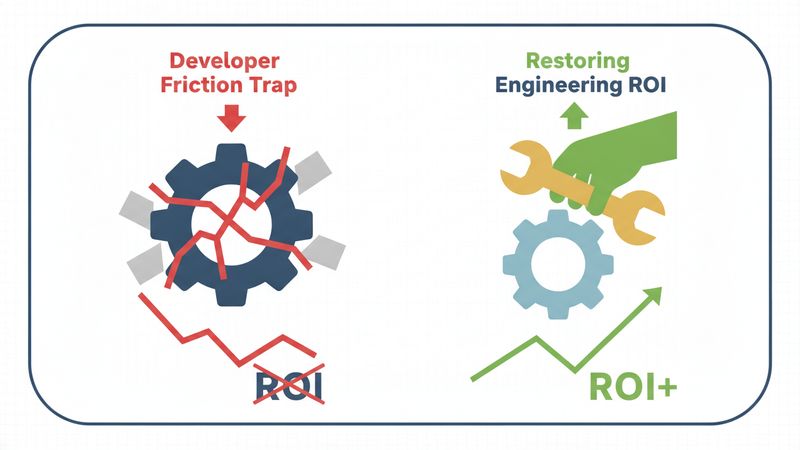
Mounting operational cognitive load is stalling software delivery. Discover how internal developer platforms cut friction and restore engineering ROI.
For mid-market and enterprise executive teams, software engineering payroll often represents one of the largest single budget items. Yet, despite aggressive hiring and investment in modern cloud tooling, business leaders across North America are seeing release cycles slow down rather than accelerate. If your team takes weeks to deploy standard features, the problem is rarely developer motivation or coding talent; it is the hidden operational friction of modern software delivery.
According to Gartner research, software complexity has grown so acute that up to 80% of major software engineering organizations are establishing dedicated platform engineering teams to provide reusable services and automated self-service workflows. As software delivery ecosystems fracture into dozens of disconnected tools, businesses are realizing that unmanaged developer cognitive load is silently destroying their technology ROI.
The Real Cost of "You Build It, You Run It"
The original DevOps philosophy of full end-to-end developer ownership was designed to eliminate organizational silos. However, without centralized governance and automated guardrails, that autonomy has metastasized into overwhelming operational burden. Instead of focusing on writing high-value business logic, developers now spend substantial portions of their week wrangling infrastructure templates, resolving Kubernetes access tickets, fixing CI/CD pipeline breakage, and deciphering compliance policies.
Recent data from DORA research underscores that developer productivity is frequently swallowed by "downstream disorder"—bottlenecks in testing, security approvals, and deployment pipelines. When individual engineers must become part-time cloud architects, database administrators, and security specialists, several severe business penalties emerge:
- Extended Time-to-Market: Feature releases that should take days stall in staging environments, delaying revenue-generating product rollouts.
- Senior Talent Burnout: Your most expensive senior software architects spend their hours troubleshooting pipeline configurations and hand-holding onboarding developers instead of driving strategic architecture.
- Runaway Cloud Costs: Autonomous development teams spin up redundant, unmonitored staging and testing environments across disparate AWS, Azure, or GCP accounts without centralized FinOps oversight.
- Heightened Security and Compliance Exposure: Inconsistent deployment practices leave configuration drift, open vulnerabilities, and compliance gaps across cloud production workloads.
Consider a mid-size financial services firm in Toronto trying to roll out a client portal upgrade. With six fragmented product squads operating their own independent deployment scripts, every quarterly compliance audit triggers weeks of code freezes and manual reconciliation. Rather than accelerating customer onboarding, the organization faces compounding operational drag and ballooning engineering overhead.
The Strategic Shift to Internal Developer Platforms
To break free from this bottleneck, mature technology organizations are pivoting toward platform engineering. Rather than forcing every product team to reinvent infrastructure provisioning, leaders build an Internal Developer Platform (IDP) that treats infrastructure and deployment pipelines as internal products.
An effective internal developer platform provides developers with "Golden Paths"—pre-architected, compliant, and automated self-service workflows. Instead of submitting infrastructure tickets or manually crafting cloud configuration files, developers can spin up secure test environments, provision databases, and run automated CI/CD pipelines via a unified portal with zero operational friction.
According to Google Cloud research, mature adopters of internal developer platforms report up to 71% faster time-to-market compared to less mature peers. Standardizing infrastructure pathways delivers measurable executive outcomes:
- Predictable Delivery Timelines: Standardized CI/CD automation cuts deployment lead times from weeks to minutes while maintaining strict security baselines.
- Reduced Onboarding Overhead: New software engineers reach full productivity in days rather than months because platform standards abstract away underlying infrastructure complexity.
- Continuous Governance and Cost Control: Centralized provisioning policies enforce automated cloud cost tagging, right-sizing, and role-based access control by default.
Practical Steps to Eliminate Delivery Friction
Modernizing your software delivery pipeline does not require a risky multi-year infrastructure overhaul. Executive leaders can take concrete, phased steps to restore engineering efficiency:
1. Map Value Stream Bottlenecks
Audit your existing development lifecycle from code commit to production release. Identify where engineering hours are lost—whether waiting on manual QA sign-offs, database provisioning, or security gate approvals.
2. Establish Standardized "Golden Paths"
Identify the 20% of repeatable application architectures that power 80% of your business workloads. Standardize templates for CI/CD pipelines, container runtime environments, and database connectors so developers do not have to configure them from scratch.
3. Treat the Platform as a Product
Engage with your development teams as internal customers. Measure platform success through clear business metrics: deployment frequency, lead time for changes, mean time to recovery, and developer satisfaction scores.
4. Partner with Specialized Engineering Experts
Building resilient DevOps automation and platform infrastructure requires deep, specialized cloud architecture capabilities that many internal teams lack bandwidth to construct alone. Partnering with seasoned modernization consultants allows your core product engineers to stay focused on commercial product delivery.
Based in Toronto, Arepitas Technologies Inc helps growing Canadian enterprises design and implement high-efficiency developer platforms, automated CI/CD pipelines, and cloud governance frameworks. By removing operational drag and engineering bottlenecks, our team enables your development organization to ship secure, scalable software faster and with higher ROI. Explore our comprehensive software delivery and modernization capabilities on our services page.
Conclusion: Turning Engineering Overhead into Competitive Advantage
As software delivery environments grow increasingly intricate, leaving infrastructure management on the shoulders of individual developers is no longer a viable scaling strategy. Forward-looking Canadian organizations that invest in platform engineering and automated golden paths unlock substantial delivery velocity, lower attrition, and protect their bottom line. By treating developer experience as a strategic business priority, executive leaders can turn their engineering operations from a sluggish cost center into an agile growth engine.
Sources
Need help with devops & platform engineering?
Arepitas Technologies Inc helps companies in Toronto build software, AI features, and digital products that scale.
Book a Free ConsultationRelated Articles
The Platform Adoption Trap: Reclaiming DevOps Margins
Engineering leaders pour millions into internal developer platforms, yet 68% struggle to prove ROI. Discover how to turn DevOps spend into delivery velocity.
The Delivery Bottleneck: Why Engineering Velocity Stalls
Engineering teams waste up to 40% of their time navigating deployment roadblocks. Here is how internal platforms restore delivery speed and business ROI.
Platform Engineering for Enterprise AI: Scale to Production
Platform engineering for enterprise AI bridges the gap between chaotic pilots and production scale, cutting cloud friction, toil, and spiraling inference costs.