Platform Engineering for Enterprise AI: Scale to Production
Platform engineering for enterprise AI bridges the gap between chaotic pilots and production scale, cutting cloud friction, toil, and spiraling inference costs.
For enterprise IT leaders, the experimental honeymoon phase of generative artificial intelligence has officially ended. Over the past two years, engineering departments successfully verified that foundation models could write code, summarize complex contracts, and process customer inquiries. However, turning isolated proof-of-concepts into resilient, observable, and cost-governed software systems has emerged as an unprecedented operational bottleneck. Today, platform engineering for enterprise AI has become the central battleground for technology leaders striving to deliver sustainable value without ballooning technical debt or cloud spend.
Rather than treating AI applications as one-off science experiments requiring isolated architectures, forward-thinking organizations are extending modern platform engineering principles—such as Internal Developer Platforms (IDPs), GitOps, infrastructure-as-code, and policy-as-code—to operationalize machine learning workflows alongside standard enterprise applications.
The Production Chasm: Why Enterprise AI Pilots Stall
While enterprise spending on AI technologies continues to surge, moving applications from developer sandboxes to mission-critical production remains difficult. According to research from The Futurum Group, roughly 52% of organizations remain stuck in the early experimentation or piloting stages of generative AI maturity. The primary constraint is no longer raw model capability or API availability; it is the total lack of standardized platform infrastructure required to govern, deploy, and monitor composite AI workloads at scale.
Several systemic pain points are widening this production gap:
- Runaway Inference and Token Costs: As reported by CIO, moving AI from pilot to production introduces profound financial unpredictability. Every prompt evaluation, iterative multi-agent loop, and API retry compound exponentially across millions of requests, often leaving finance teams blindsided by mid-month cloud invoices.
- Disjointed Toolchains and Developer Friction: Application developers frequently navigate separate, unintegrated stacks for model registry, vector databases, prompt management, and cloud orchestration, leading to duplicated infrastructure and cognitive overload.
- Legacy System Integration Barriers: Connecting cutting-edge retrieval-augmented generation (RAG) pipelines to legacy enterprise data stores and mainframes exposes brittle data pipelines, latency bottlenecks, and strict data residency compliance risks.
Shifting Down: Embedding Model Governance into Developer Platforms
To bridge the production chasm, enterprise engineering leaders are transitioning away from "shifting left"—which dumped security, compliance, and cloud cost burdens directly onto developer shoulders—to "shifting down." By embedding AI governance, networking, and deployment pipelines directly into underlying platform infrastructure, platform teams create self-service Golden Paths that accelerate feature delivery while enforcing compliance automatically.
Standardizing CI/CD, GitOps, and Policy-as-Code for LLMs
Generative AI introduces non-deterministic behavior that standard software testing frameworks were never built to handle. In a platform-driven approach, model versions, prompt templates, vector embeddings, and RAG schemas are managed via GitOps workflows. Automated testing suites evaluate prompt drift, toxic outputs, and accuracy degradation before deployment, ensuring that updates can be audited and rolled back just like microservice application containers.
Through policy-as-code tooling (such as Open Policy Agent), platform engineers can enforce mandatory guardrails at the gateway level. For instance, sensitive customer identifiers or proprietary source code can be scrubbed automatically before payloads traverse public LLM APIs.
Unifying Observability and SRE Workflows
Traditional application monitoring metrics—such as CPU utilization and HTTP error codes—fail to capture the subtle failures of generative AI systems, such as hallucination rates, semantic drift, and token latency. Findings highlighted in The State of SRE and Platform Engineering Report reveal that 67% of Site Reliability Engineers (SREs) now identify AI model monitoring and evaluation as their top priority, yet fragmented tooling remains their greatest operational barrier.
Modern platform architectures resolve this by ingesting model evaluations, Time to First Token (TTFT), and P99 token latency metrics directly into unified telemetry dashboards. This enables engineering teams to triage agent workflow failures with the same precision they apply to distributed cloud microservices.
For enterprises modernizing complex legacy architectures to support modern deployment platforms, exploring end-to-end cloud infrastructure and modernization services provides the architectural framework necessary to eliminate friction.
Architectural Blueprints: Dynamic Routing and AI FinOps
Scaling enterprise AI requires sustainable unit economics. High-performing engineering teams are turning to intelligent AI Gateway layers that decouple developers from specific foundation models and implement dynamic request routing.
+-------------------------------------------------------------+
|                   Enterprise Client Layer                   |
+-------------------------------------------------------------+
                               |
                               v
+-------------------------------------------------------------+
|               AI Gateway & FinOps Control Plane             |
|  - Token Rate Limiting   - PII Redaction & Policy as Code   |
|  - Dynamic Model Router  - Real-Time Cost Attribution       |
+-------------------------------------------------------------+
         |                                     |
         v                                     v
+-----------------------+           +-------------------------+
| High-Complexity Tasks |           | High-Volume Fast Tasks  |
| Frontier Cloud LLMs   |           | Self-Hosted SLMs        |
| (Deep Reasoning/Code) |           | (Phi-4, Gemma, Llama)   |
+-----------------------+           +-------------------------+
As explored in the InfoQ Cloud and DevOps Trends Report, pragmatic enterprise architecture leans heavily on hybrid topologies. By routing high-volume, repetitive tasks (such as metadata classification and text extraction) to self-hosted Small Language Models (SLMs) and reserving expensive frontier models exclusively for complex multi-step reasoning, organizations are slashing API overhead by up to 70% while improving response latency.
The Platform Engineering Roadmap for AI Maturity
To move beyond ad-hoc experimentation and build a sustainable AI engineering foundation, enterprise tech leaders should prioritize four key milestones:
- Establish a Centralized AI Gateway: Route all corporate AI API traffic through a unified proxy to enforce rate limits, cost allocations, and data-loss prevention policies.
- Standardize Self-Service Golden Paths: Provide application developers with pre-configured templates for vector databases, model deployment pipelines, and evaluation harnesses within your internal developer portal.
- Integrate FinOps at the Model Level: Track token consumption per feature, business unit, and customer journey, treating AI inference costs as a core product unit economic.
- Adopt Hybrid Model Topologies: Evaluate fine-tuned open-source small language models on private Kubernetes infrastructure for repetitive tasks rather than relying exclusively on proprietary cloud APIs.
By treating generative AI as a first-class workload governed by robust platform engineering practices, enterprises can systematically transition from brittle pilots to scalable, cost-efficient, and secure production systems.
Sources
Need help with devops & platform engineering?
Arepitas Technologies Inc helps companies in Toronto build software, AI features, and digital products that scale.
Book a Free ConsultationRelated Articles
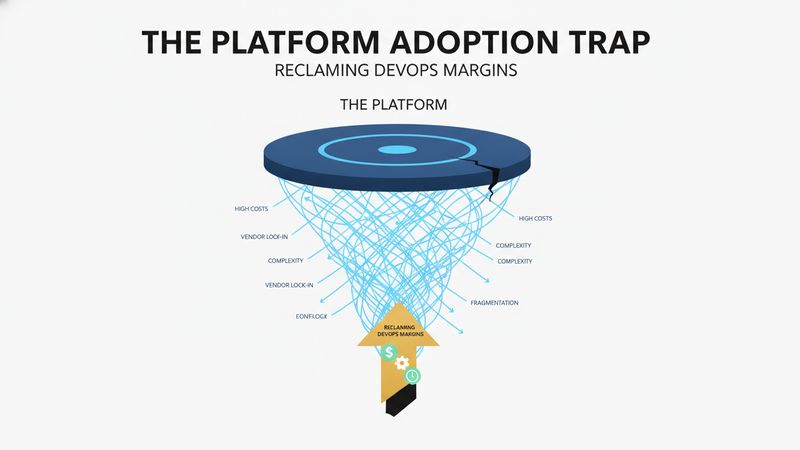
The Platform Adoption Trap: Reclaiming DevOps Margins
Engineering leaders pour millions into internal developer platforms, yet 68% struggle to prove ROI. Discover how to turn DevOps spend into delivery velocity.
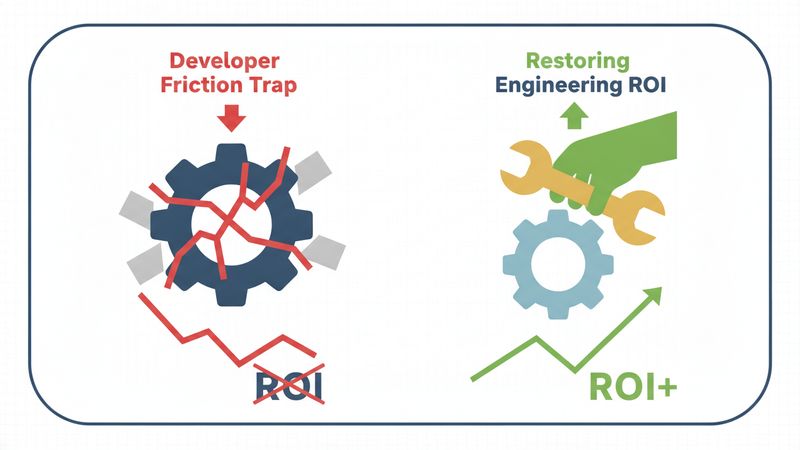
The Developer Friction Trap: Restoring Engineering ROI
Mounting operational cognitive load is stalling software delivery. Discover how internal developer platforms cut friction and restore engineering ROI.
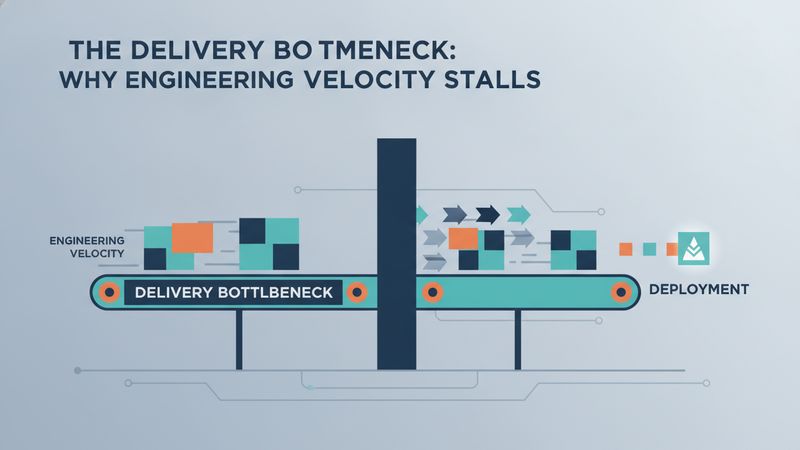
The Delivery Bottleneck: Why Engineering Velocity Stalls
Engineering teams waste up to 40% of their time navigating deployment roadblocks. Here is how internal platforms restore delivery speed and business ROI.