The Delivery Bottleneck: Why Engineering Velocity Stalls
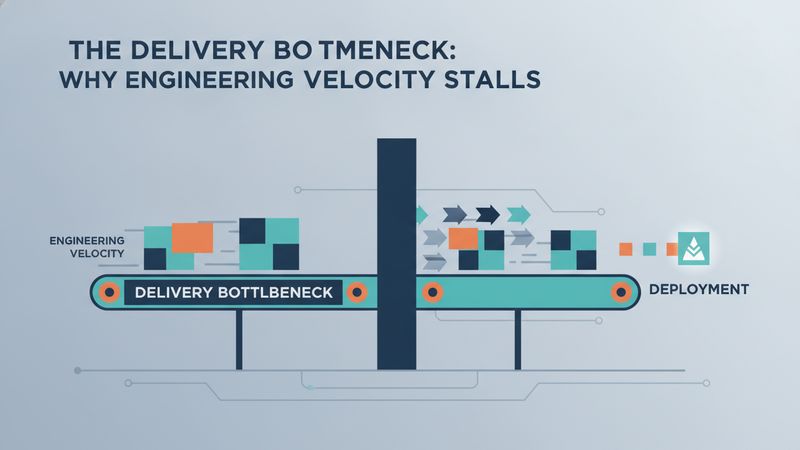
Engineering teams waste up to 40% of their time navigating deployment roadblocks. Here is how internal platforms restore delivery speed and business ROI.
For mid-market and enterprise leadership, few line items in the annual budget represent a larger investment than engineering payroll. Yet executive teams across Canada consistently report a frustrating paradox: despite hiring talented developers and adopting sophisticated cloud stacks, engineering velocity has slowed to a crawl. New feature launches that once took weeks now stretch across quarters, while bug fixes and system updates get bogged down in administrative queues and manual infrastructure reviews.
This slowdown is not a failure of individual developer talent. It is the direct result of a structural delivery bottleneck. As modern cloud environments, Kubernetes architectures, and microservices have grown increasingly intricate, developers spend an estimated 30% to 40% of their working hours wrestling with infrastructure tickets, environment provisioning, and compliance checklists rather than writing business logic. According to Google Cloud's 2025 DORA Report, while individual teams are adopting automation faster than ever, productivity gains are routinely swallowed by downstream disorder—unstandardized deployment pipelines, fragmented tooling, and manual handoffs.
For C-suite leaders and operations directors, solving this friction is no longer an IT operational detail; it is a fundamental driver of operational profitability and time-to-market advantage.
The Real Cost of Developer Cognitive Load
When engineering organizations lack standardized delivery paths, every new software feature requires developers to reinvent operational workflows. Instead of focusing on customer-facing revenue drivers, engineers end up acting as part-time systems administrators, security coordinators, and cloud architects.
Consider the hidden business costs generated by this operational friction:
- Extended Time-to-Market: When preparing a staging or testing environment requires multiple cross-team requests and ticket approvals, release cycles drag from days to months, delaying revenue realization.
- Inflated Cloud Waste: Without automated guardrails, developers frequently spin up unoptimized, non-standard cloud resources that run indefinitely, inflating monthly infrastructure bills without business justification.
- Elevated Operational Risk: Manual configuration and ad-hoc deployment scripts dramatically increase the likelihood of production outages, configuration drift, and compliance oversights.
- Developer Turnover and Burnout: Top technical talent seeks to build high-impact customer software. Forcing senior engineers to spend half their week troubleshooting pipeline scripts leads directly to retention challenges in competitive markets like Toronto and the GTA.
Research from Gartner projects that by 2026, 80% of major software organizations will establish dedicated platform engineering teams to build reusable services and internal developer platforms (IDPs). The goal is simple: eliminate cognitive load and provide automated, self-service infrastructure that turns technical delivery into a predictable product.
Case in Point: Overcoming Infrastructure Gridlock in Ontario
To see how this dynamic plays out in practice, consider a mid-market financial services firm based in Toronto. Over three years of steady growth, the company expanded its engineering team from 15 to 65 developers. However, rather than seeing a fourfold increase in product output, release cadence actually declined by nearly 50%.
Every sprint required developers to wait on a small, overwhelmed central infrastructure team to configure secure database instances, set up access permissions, and provision cloud testing environments. A single feature deployment required coordinating across four separate toolsets and three manual approval stages. Highly compensated software engineers were spending nearly 18 hours per week simply waiting for or configuring environments.
By transitioning from ad-hoc ticket queues to a centralized internal developer platform with "golden paths"—standardized, pre-approved self-service deployment pipelines—the organization transformed its operational efficiency:
- Environment provisioning time plummeted from 5 business days to less than 15 minutes through automated self-service.
- Deployment frequency increased by 300%, enabling weekly client-facing feature rollouts instead of monthly fire drills.
- Infrastructure support tickets dropped by 65%, freeing senior systems architects to focus on platform security and cost governance rather than repetitive administrative setups.
How Business Leaders Can Reclaim Engineering Velocity
Fixing engineering bottlenecks requires leadership to view infrastructure not as a reactive help desk, but as an internal digital product built to accelerate core business outcomes. Business leaders should guide their organizations through three practical steps:
1. Audit Developer Time Allocation and Hand-Offs
Before purchasing new tooling or hiring additional personnel, benchmark where your engineering hours are actually going. Measure the cycle time from code completion to production release, and quantify how many days are lost to environment provisioning, security reviews, and manual deployments. If developers spend more than 20% of their sprint on non-coding operational overhead, your organization has a platform debt problem.
2. Standardize on Self-Service "Golden Paths"
Empower developers with pre-architected, compliant development paths that make the right operational choice the easiest choice. Self-service portals should allow engineers to provision standardized cloud infrastructure, automated CI/CD pipelines, and security controls with a single click, eliminating cross-departmental ticket backlogs while enforcing company-wide governance automatically.
3. Align DevOps Metrics with Business KPIs
Move beyond vanity metrics like total lines of code or commit counts. Track operational performance using standardized delivery benchmarks, such as deployment frequency, lead time for changes, and change failure rate. When delivery pipelines become frictionless, tech investment translates directly into faster customer feedback loops and higher revenue per engineer.
Accelerate Delivery with the Right Implementation Partner
Building an effective platform engineering strategy requires a balance of enterprise-grade security, cloud architecture discipline, and an empathetic understanding of developer workflows. For many mid-sized and enterprise businesses, attempting to construct an internal developer platform from scratch without external guidance risks creating another layer of complex, unmaintained tooling.
Based in Toronto, Arepitas Technologies Inc works alongside Canadian business leaders and IT executives to modernize delivery infrastructure, eliminate operational friction, and implement reliable internal developer platforms. Explore our end-to-end engineering and cloud services to discover how a tailored platform strategy can unlock your team's true engineering velocity and drive measurable ROI from your technology investments.
Sources
Need help with devops & platform engineering?
Arepitas Technologies Inc helps companies in Toronto build software, AI features, and digital products that scale.
Book a Free ConsultationRelated Articles
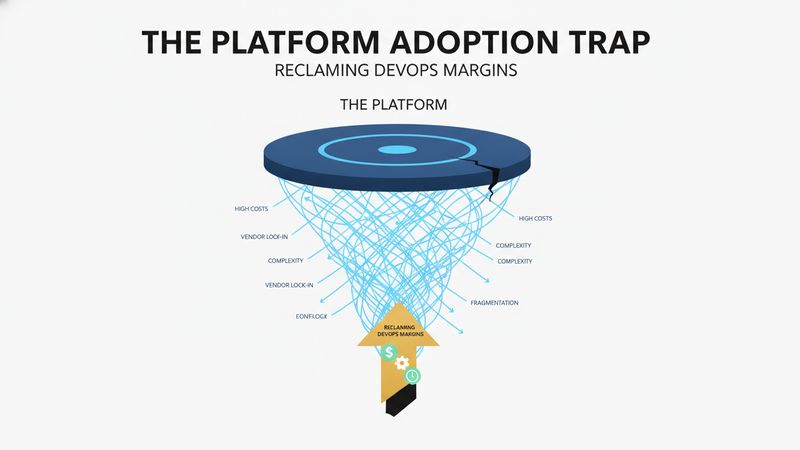
The Platform Adoption Trap: Reclaiming DevOps Margins
Engineering leaders pour millions into internal developer platforms, yet 68% struggle to prove ROI. Discover how to turn DevOps spend into delivery velocity.
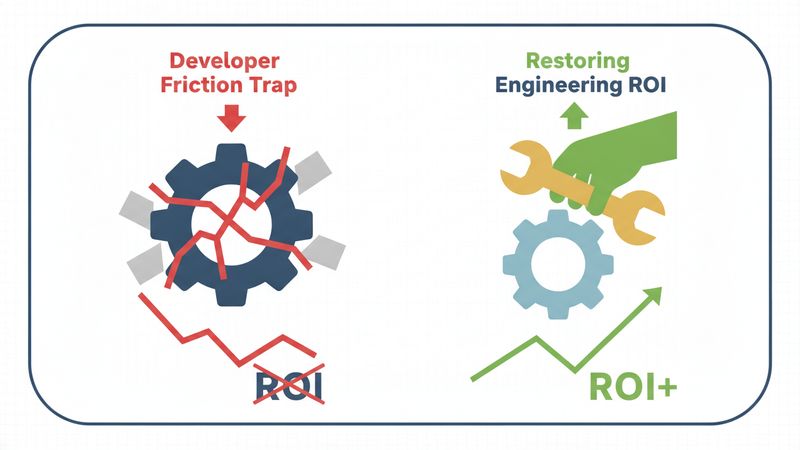
The Developer Friction Trap: Restoring Engineering ROI
Mounting operational cognitive load is stalling software delivery. Discover how internal developer platforms cut friction and restore engineering ROI.
Platform Engineering for Enterprise AI: Scale to Production
Platform engineering for enterprise AI bridges the gap between chaotic pilots and production scale, cutting cloud friction, toil, and spiraling inference costs.