The Data Integration Trap: How App Sprawl Stalls Growth
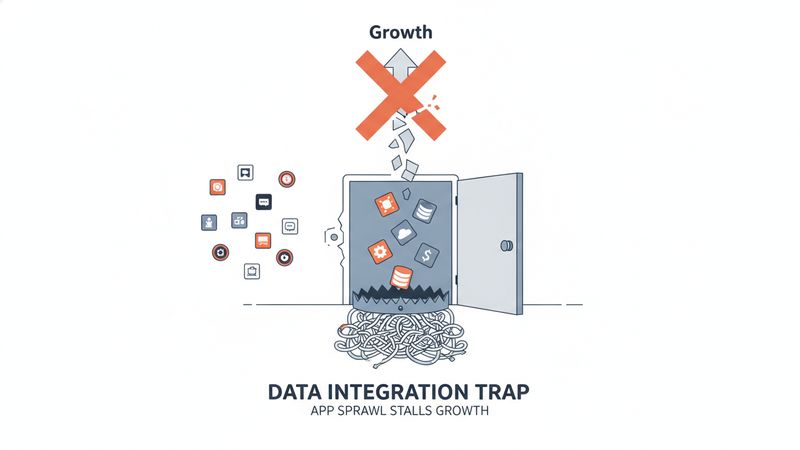
With over 70% of enterprise tools disconnected, data integration gaps are stalling growth. Here is how leaders are unifying systems to protect margins.
For mid-market and enterprise leadership teams across Ontario and Canada, enterprise software investment has never been higher. Yet despite adopting specialized tools for sales, enterprise resource planning, customer support, and supply chain management, executive teams are discovering an unsettling reality: operational velocity is slowing down, not accelerating. Modern organizations now manage hundreds of discrete applications, but critical business data integration remains the primary operational bottleneck. When core applications operate in isolated silos, leadership loses visibility, cross-functional execution breaks down, and software budgets fail to deliver measurable bottom-line value.
Recent enterprise research reveals that while mid-size and large companies manage an average of nearly 900 applications, only 28% to 29% are actively integrated. The remaining 70%+ operate in functional isolation. According to the 1H 2026 Enterprise Software Decision Maker Survey by The Futurum Group, 41% of IT leaders are now actively planning to reduce application sprawl and consolidate onto unified data architectures, as fragmented toolsets directly erode operating profit. When critical data is trapped between legacy on-premises databases, point-solution SaaS tools, and disparate cloud warehouses, the business pays a recurring tax in lost revenue and manual labor.
The Real Business Cost of Disconnected Data
When systems fail to communicate in real time, business consequences ripple across the entire organization. Decision-makers often evaluate software purchases on standalone departmental merits, overlooking the cumulative drag that data fragmentation places on company-wide efficiency.
- Revenue Leakage and Billing Delays: When front-office customer relationship management (CRM) platforms are decoupled from back-office billing and ERP platforms, order fulfillment cycles drag on. Pricing updates, contract modifications, and invoice reconciliations require hours of manual oversight, directly slowing cash flow.
- Inflated Operational Overhead: According to industry analysis, engineering and business teams spend nearly 30% of their weekly capacity performing data preparation, custom export handling, and manual spreadsheet synchronization across disconnected tools.
- Stalled Digital and Automation Initiatives: Industry benchmarks show that 95% of technology leaders cite integration friction as the primary obstacle blocking scalable automation and modernization programs. Without a reliable data fabric, advanced analytics and automated workflows produce inaccurate outputs that erode customer trust.
Consider a mid-market distribution firm in the Greater Toronto Area operating warehouse management on an on-premises legacy database, sales through a cloud CRM, and customer support via a third-party portal. Because inventory levels do not synchronize automatically, sales teams frequently overcommit stock, creating order cancellations and costly customer concessions. The company attempted to fix this by purchasing another visibility dashboard, only to find that another disconnected tool compounded the original data fragmentation problem.
Rearchitecting for Unified Business Workflows
Solving the integration bottleneck requires shifting from ad-hoc tool acquisition to intentional integration architecture. Business leaders should focus on foundational changes that bridge legacy platforms with modern cloud infrastructure:
1. Shift from Best-of-Breed Sprawl to Integrated Platforms
The era of buying isolated point solutions for every minor departmental preference is giving way to unified data foundations. Enterprise evaluations should prioritize software platforms and custom architectures that support open API connectivity, bidirectional data synchronization, and automated data pipelines over closed proprietary ecosystems.
2. Modernize the Integration Layer, Not Just the Front End
Many organizations attempt cosmetic upgrades—such as redesigning web interfaces or buying standalone reporting dashboards—while leaving brittle, batch-file data exchanges intact. High-performing enterprises build secure, real-time API layers around their core systems, enabling transactional data to move between legacy infrastructure and cloud applications with millisecond latency.
3. Establish Clear P&L Governance for Integrations
Rather than measuring software success by feature adoption alone, quantify integration ROI against operational KPIs: reduction in manual data entry hours, acceleration of order-to-cash cycle times, and the elimination of redundant software seat licenses.
Turning Data Connectivity into a Competitive Edge
Bridging legacy databases and modern business applications does not require an expensive, multi-year overhaul of your entire technology stack. By implementing modular API orchestration, targeted data pipelines, and unified web portals, companies can streamline day-to-day operations and eliminate costly manual handoffs.
As a Toronto-based custom software and technology consulting firm, Arepitas Technologies Inc helps mid-market enterprises across Canada untangle complex legacy systems, build reliable data integrations, and automate critical business workflows. Explore our bespoke software architecture and development services to discover how a tailored data strategy can reduce operational costs and accelerate your growth.
Sources
Need help with data & analytics?
Arepitas Technologies Inc helps companies in Toronto build software, AI features, and digital products that scale.
Book a Free ConsultationRelated Articles
The Data Downtime Tax: How Broken Pipelines Drain Margins
Unchecked data downtime costs enterprises over $49,000 an hour in flawed decisions. Here is how leaders restore data integrity to protect operational margins.
The Dark Data Trap: Turning Wasted Storage Into ROI
Most enterprise data sits unused in cold storage. Discover how Canadian leaders can eliminate dark data waste and turn buried operational insights into profit.
Enterprise AI ROI: Bridging Data Debt and Legacy Silos
Enterprise AI ROI remains stalled for many organizations due to legacy data debt and unstructured silos. Here is how modern IT leaders bridge the gap in 2026.