The Data Downtime Tax: How Broken Pipelines Drain Margins
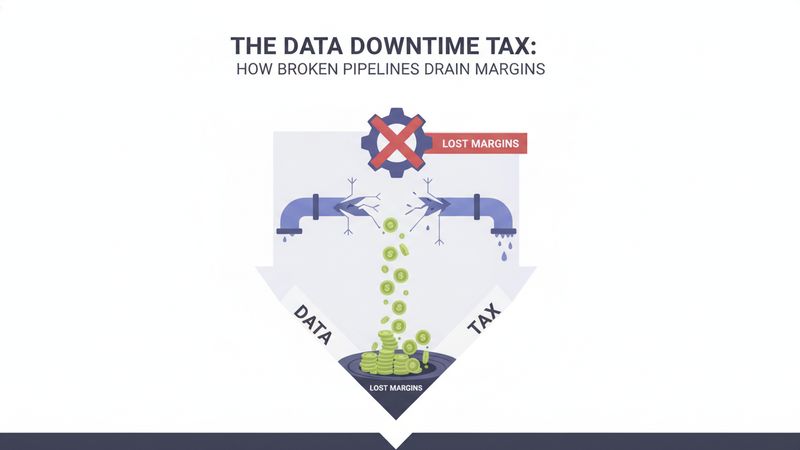
Unchecked data downtime costs enterprises over $49,000 an hour in flawed decisions. Here is how leaders restore data integrity to protect operational margins.
For executive leadership, few moments are more unsettling than learning that the revenue, inventory, or billing numbers presented to the board were wrong. It rarely happens because an executive made a bad calculation; it happens because the underlying pipelines feeding the business dashboard silently broke three days prior. This operational failure is known as data downtime—the period during which critical operational data is missing, corrupted, delayed, or out of sync. While IT infrastructure uptime often exceeds 99.9%, data reliability frequently falls far short, quietly draining company margins and sabotaging executive decisions.
According to research from the Fivetran Enterprise Data Infrastructure Benchmark, data downtime incurs an estimated business impact of $49,600 per hour, surging to upwards of $75,200 per hour for larger enterprises. Furthermore, nearly 30% of organizations suffer project delays of a month or more due to pipeline maintenance and integration failures. Compounded with Gartner research on data quality, which estimates poor data quality costs organizations an average of $12.9 million annually, data fragility is no longer an isolated engineering ticket—it is a material risk to enterprise valuation.
The Silent Cost of Broken Pipelines
Unlike an e-commerce checkout outage or cloud server crash that immediately triggers high-priority alerts, data pipeline failures are notoriously silent. A pipeline that produces corrupt data often produces zero error codes.
This dynamic creates severe operational friction across departments:
- Erosion of Decision Velocity: When leadership realizes reporting metrics cannot be fully trusted, every strategic decision requires days of manual spreadsheet audits, slowing time-to-market.
- Stakeholders as First Responders: Research from the Monte Carlo State of Data Quality Survey shows that 74% of data incidents are first identified by business users rather than engineering tools, with average resolution times climbing to 15 hours per incident.
- Failed Digital and AI Initiatives: In PwC's 2026 Digital Trends in Operations Survey, 87% of operations leaders confirmed that poor data quality hampered their ability to capture business value from digital transformation and automated workflows.
- Engineering Resource Drain: Data teams spend up to 70% of their weekly capacity patching broken cron jobs, updating brittle custom connectors, and reconciling conflicting datasets instead of delivering high-impact business products.
When analytics feeds fail silently, organizations make high-stakes procurement, staffing, and pricing bets on phantom numbers.
Real-World Scenario: A Toronto Supply Chain Operator Caught Off Guard
Consider the operational impact on a mid-sized multi-channel distribution company operating out of the Greater Toronto Area (GTA). Serving retail and wholesale partners across Ontario and Quebec, the company relied on overnight batch integrations connecting their warehouse management system (WMS), point-of-sale platforms, and enterprise resource planning (ERP) system.
Following an unannounced third-party API update, the automated data pipeline syncing stock counts between the Mississauga distribution center and the digital ordering platform quietly failed. Because the extract job still returned a successful HTTP status code, no alerts fired. For five consecutive business days, the executive sales dashboard reflected healthy buffer inventory.
By the time customer service began receiving complaints about delayed shipments, the business had oversold hundreds of high-margin SKUs. The fallout was immediate: emergency vendor drop-ship fees, expedited freight surcharges exceeding $70,000 to salvage major contracts, and weeks of executive time spent reassuring angry enterprise clients. The incident was not caused by a failure of sales strategy, but by brittle data architecture that lacked basic data observability and schema monitoring.
Actionable Strategies to Eliminate Data Downtime
Eliminating data downtime does not mean purchasing another expensive visualization license or completely rewriting your technology stack. It requires shifting data management from reactive firefighting to proactive, governed engineering.
1. Implement Automated Data Observability
Traditional software application monitoring checks whether servers are running; data observability checks whether data is accurate, fresh, and consistent. Implement automated checks that monitor:
- Freshness SLAs: Flagging pipelines immediately if daily transactional tables fail to refresh by 5:00 AM.
- Volume and Schema Drift: Catching unexpected drops in record counts or column modifications before downstream reports ingest them.
- Distribution Anomalies: Detecting sudden spikes in null values, negative pricing figures, or duplicate customer IDs automatically.
2. Modernize Away from Custom Script Sprawl
Many mid-market companies still rely on hundreds of custom Python scripts written by past contractors. When APIs update or database schemas evolve, these bespoke scripts break without warning. Migrating to managed ingestion pipelines with built-in resilience reduces maintenance overhead and lets technical staff focus on strategic analytics rather than pipe maintenance.
3. Establish a Single Certified Semantic Layer
When finance, sales, and operations calculate "gross customer margin" using three different formulas across disconnected spreadsheets, decisions stall. Establishing a single semantic layer ensures that business metrics are centrally governed, version-controlled, and uniform regardless of which department opens a dashboard.
4. Align Data Governance with Commercial Accountability
Data hygiene cannot remain an abstract IT chore. Operations directors and domain leads must own data validation rules within their spheres of influence. When departmental performance metrics are tied to the accuracy of inputs into the central system, data cleanliness becomes an enterprise-wide priority.
Building Resilient Foundations for Tomorrow's Operations
In a market environment where Canadian enterprises are balancing tighter operational margins with the rush toward automated and agentic AI systems, clean data pipelines are no longer optional. AI models and executive teams share one defining trait: neither can deliver defensible value when fueled by inaccurate inputs.
Eliminating data downtime requires treating your internal data architecture with the same rigorous engineering standards applied to production customer software. At Arepitas Technologies Inc, we partner with Toronto-based and North American business leaders to conduct full data stack audits, replace brittle pipelines, and deploy robust, observable data architectures. Explore our specialized engineering and architectural offerings across our services page to discover how we turn vulnerable data plumbing into an accurate, reliable engine for commercial growth.
Sources
Need help with data & analytics?
Arepitas Technologies Inc helps companies in Toronto build software, AI features, and digital products that scale.
Book a Free ConsultationRelated Articles
The Dark Data Trap: Turning Wasted Storage Into ROI
Most enterprise data sits unused in cold storage. Discover how Canadian leaders can eliminate dark data waste and turn buried operational insights into profit.
The Data Integration Trap: How App Sprawl Stalls Growth
With over 70% of enterprise tools disconnected, data integration gaps are stalling growth. Here is how leaders are unifying systems to protect margins.
Enterprise AI ROI: Bridging Data Debt and Legacy Silos
Enterprise AI ROI remains stalled for many organizations due to legacy data debt and unstructured silos. Here is how modern IT leaders bridge the gap in 2026.