The Operational Friction Crisis: Fixing Disconnected IT
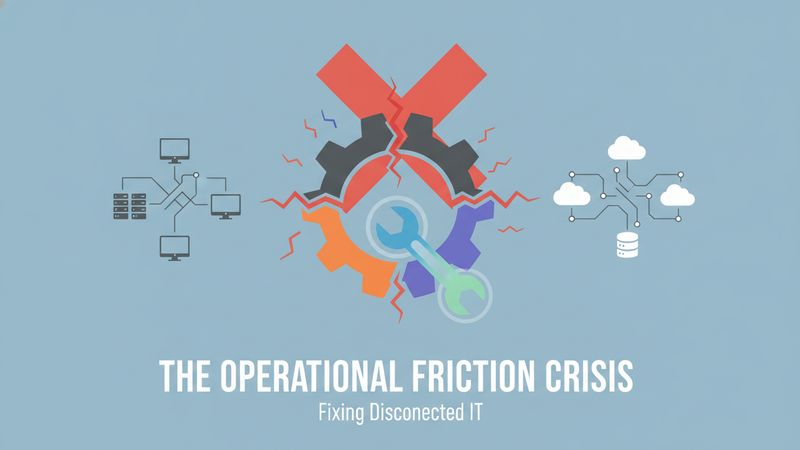
Discover why Canadian mid-market leaders face crippling operational friction from fragmented software and how workflow modernization unlocks real business ROI.
For mid-market business leaders across Canada, a frustrating paradox is unfolding across the balance sheet. IT investments and software budgets are growing at double-digit rates, yet daily operations feel slower, more fragile, and increasingly bureaucratic. While executive boards expect technology deployments to drive immediate margin expansion, frontline teams find themselves buried in manual data re-entry, redundant approvals, and spreadsheet workarounds. Achieving real business ROI now requires a deliberate shift toward workflow modernization—replacing patchwork tool stacks with unified, purpose-built business systems.
Recent data underscores the severity of this execution gap. According to BDO Canada's Productivity Paradox 2026 report, while Canadian organizations are investing aggressively in new digital capabilities, 46 percent report experimenting with digital and automation tools without realizing meaningful business ROI. Furthermore, research from the Business Development Bank of Canada (BDC) reveals that while 96 percent of mid-sized enterprises have digitized core functions, uneven integration costs the Canadian economy tens of billions in unrealized productivity. Technology spending alone does not create operational leverage; poorly connected systems actively destroy it.
The Hidden Cost of Workaround Debt
When software tools fail to align with how an enterprise actually creates value, employees inevitably invent "shadow workflows". In business operations, this is known as workaround debt—the compounding cost of bridging incompatible applications with manual labour.
Consider a mid-sized logistics and supply chain firm in the Greater Toronto Area. Over five years of growth, the company onboarded an enterprise resource planning (ERP) system, a cloud customer relationship management (CRM) platform, a third-party billing platform, and several specialized dispatch tools. On paper, the organization possessed a modern technology stack. In practice:
- Duplicate Data Entry: Customer service representatives spent 15 to 20 minutes copying order manifests between disconnected systems, introducing error rates that triggered costly billing disputes.
- Siloed Reporting: Executive managers waited until the end of each fiscal month for manual spreadsheet reconciliations to assess line-item profitability.
- Customer Friction: Order tracking inquiries required internal cross-departmental emails rather than real-time portal lookups, directly impacting client retention.
This friction is not an edge case. Research from CGI indicates that legacy operational bottlenecks and fragmented core architectures remain the single biggest barrier to transformation for 49 percent of Canadian businesses. When teams spend a third of their working hours maintaining administrative glue, payroll is spent managing software limitations rather than driving commercial growth.
Why Off-the-Shelf Band-Aids Fail the Mid-Market
When operational friction peaks, leadership often attempts a quick fix by purchasing another commercial off-the-shelf (COTS) SaaS subscription or relying on brittle third-party integration plugins. While packaged software is effective for commodity functions like standardized payroll or email, forcing specialized operational processes into generic SaaS molds creates substantial systemic risks:
- Escalating Seat-License Penalties: SaaS vendors increasingly enforce aggressive tiered pricing and per-seat fee structures that penalize headcount growth, rapidly outstripping the cost of owning custom assets.
- Fragile Point-to-Point Connectors: Lightweight integration connectors frequently break during vendor API updates, causing silent data drops and operational disruption.
- Loss of Competitive Differentiation: Off-the-shelf platforms standardize workflows around the lowest common denominator. If your operational advantage lies in proprietary fulfillment speed, customized client reporting, or agile scheduling, a generic tool flattens your strategic advantage.
For growing mid-market enterprises, workflow modernization is not about ripping out core accounting or enterprise records; it is about building high-performance, tailored orchestration layers that link legacy databases, internal teams, and client touchpoints into a unified operating engine.
The Strategic Playbook for Workflow Modernization
Executive teams looking to eliminate process bottlenecks and capture real operational ROI should approach modernization with an engineering mindset focused on measurable business outcomes:
- Conduct an Operational Friction Audit: Map the critical paths of your core revenue-generating workflows. Identify where employees manually copy data, request offline managerial approvals, or manage spreadsheets outside protected systems. Target the single costliest bottleneck first.
- Decouple Data from Legacy Monoliths: Rather than initiating risky, multi-year core replacements, deploy secure API layers around legacy systems to liberate core records for real-time web and mobile applications.
- Build Purpose-Driven Internal Platforms: Replace disjointed SaaS tools with unified internal management portals tailored directly to your team's operational rhythm. Automated validation rules, role-based controls, and seamless database synchronization immediately eliminate manual entry errors.
- Measure Value on Cycle Times and Margin Expansion: Quantify modernization success by measuring the reduction in request turnaround times, operational error rates, and the capacity to scale transaction volumes without proportional headcount increases.
Turning Operational Agility into a Competitive Edge
In an economic environment defined by margin pressure and competitive consolidation, market leaders do not win by purchasing more software; they win by running tighter, more integrated operations. Removing friction from internal workflows directly translates into faster client turnaround, lower operational overhead, and higher enterprise valuation.
Navigating this transition requires practical software architecture and deep business alignment. As a Toronto-based digital product and software engineering consultancy, Arepitas Technologies Inc partners with mid-market enterprises across Ontario and Canada to modernize complex operational workflows, build robust internal platforms, and eliminate technical friction. By focusing on high-ROI engineering rather than generic tooling, business leaders can transform disconnected legacy systems into scalable engines of sustainable growth.
Sources
Need help with digital transformation?
Arepitas Technologies Inc helps companies in Toronto build software, AI features, and digital products that scale.
Book a Free ConsultationRelated Articles
The Digital Transformation Stall: Unlocking Mid-Market ROI
Mid-market enterprises are seeing digital transformation stall under architectural sprawl and data debt. Here is how leaders turn IT spend into measurable ROI.
The Legacy System Drain: Why Rip-and-Replace Fails ROI
Discover why over 70% of legacy software replacements fail to deliver ROI and how Canadian mid-market leaders can modernize iteratively without disruption.
The Digital Maturity Trap: How Disconnected Tech Kills ROI
Canadian firms spend billions on digital tools, yet only 10% integrate them into workflows. Here is how leaders turn fragmented tech into bottom-line ROI.