The Legacy System Drain: Why Rip-and-Replace Fails ROI
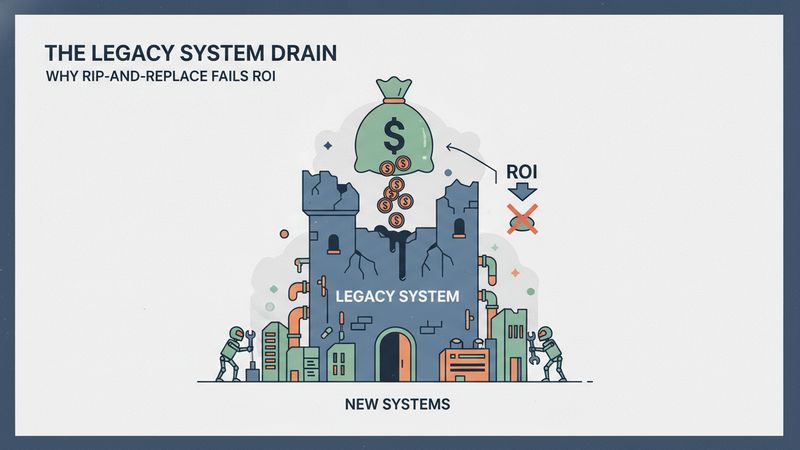
Discover why over 70% of legacy software replacements fail to deliver ROI and how Canadian mid-market leaders can modernize iteratively without disruption.
For mid-market and enterprise leadership, legacy system modernization has evolved from a back-burner technical debate into an urgent operational mandate. Worldwide IT spending is projected to hit $6.37 trillion in 2026, marking a 14.2% surge driven largely by demand for advanced software ecosystems and intelligent cloud capabilities. Yet despite historic budget allocations, industry data shows that upwards of 70% of massive, multi-year "rip-and-replace" modernization projects fail to deliver their anticipated business outcomes, suffer severe cost overruns, or get abandoned before deployment.
When executive teams attempt to scrap decades-old core systems in a single stroke, they frequently underestimate the sheer density of institutional knowledge, regulatory rules, and undocumented operational workflows baked into those platforms. Instead of unlocking competitive agility, these multi-year monolith overhauls freeze business growth, burn millions in engineering capital, and leave operational teams paralyzed.
The Financial Reality: Maintenance Traps and the Canadian Agility Gap
Maintaining legacy applications is consuming between 60% and 80% of typical corporate IT budgets. This means that for every dollar allocated to technology leadership, up to eighty cents goes simply toward keeping aging servers running, fixing patch conflicts, and managing fragile integrations.
In Canada, the modernization challenge is especially acute. In recent research surveying senior Canadian executives, 49% of business leaders identified legacy core systems as the single most persistent barrier to digital transformation and market responsiveness. With Canada's overall business productivity facing prolonged headwinds, companies that tie up their capital in perpetual maintenance cannot pivot quickly enough to meet shifting market demands.
Consider a typical scenario: A mid-size distribution and logistics company in the Greater Toronto Area (GTA) relies on a custom enterprise platform originally developed fifteen years ago. While the system reliably processes warehouse orders, it cannot natively connect to modern customer self-service portals, supplier EDI feeds, or automated analytics dashboards. The executive team initially commits to a complete multi-million-dollar replacement. Two years and several budget amendments later, the new system remains in pre-production because edge-case billing rules and custom shipping calculations were missed during initial scoping.
Why "Big-Bang" Modernization Fails Executive Expectations
When post-mortems are conducted on failed modernization initiatives, the breakdown rarely stems from purely technical shortcomings. Instead, it boils down to predictable strategic flaws in how leadership approaches transformation:
- The Undocumented Logic Deficit: Core business systems often contain fifteen to twenty years of micro-adjustments—special client discount logic, provincial tax handling, and regulatory compliance exceptions. When organizations attempt a wholesale rewrite, translating this hidden business DNA from scratch leads to critical regression bugs at cutover.
- The Multi-Year Delivery Void: Markets, vendor APIs, and customer behaviors change dramatically over an eighteen-to-twenty-four-month development cycle. A rigid "big-bang" rewrite is often obsolete by the day it is finally ready to launch.
- All-or-Nothing Operational Risk: Swapping out an entire core transactional engine overnight introduces massive operational friction. If the cutover experiences downtime or data discrepancies, front-line staff cannot process transactions, directly damaging customer retention and top-line revenue.
The Pragmatic Alternative: Incremental, API-Led Modernization
Progressive organizations are abandoning monolithic rebuilds in favor of modular, incremental modernization strategies. Rather than demolishing the house to renovate the kitchen, businesses can extract value progressively using proven architectural techniques:
1. Deploying the Strangler Fig Pattern
Instead of replacing a monolithic system at once, high-performing teams incrementally replace specific business capabilities piece by piece. New micro-services or purpose-built web modules are created alongside the legacy system, gradually routing traffic away from the legacy core until the old codebase can be retired safely without a disruptive cutover.
2. Building Resilient API Facades
Modernizing does not always require rewriting backend database tables immediately. By wrapping aging backends in standardized REST or GraphQL APIs, companies can build modern, high-speed mobile and web frontends, automate workflows, and connect third-party SaaS tools while preserving the integrity of core transactional databases.
3. Delivering Value in 90-Day Cycles
Executive teams must demand modernization roadmaps that deliver tangible business value each quarter. Whether it involves automating an invoicing bottleneck, launching a customer onboarding portal, or modernizing inventory tracking, quarterly milestones generate measurable ROI and fund subsequent modernization phases.
Leading Modernization with a Local Strategic Partner
Modernizing core systems without risking day-to-day operations requires a blend of senior systems architecture, rapid product engineering, and deep commercial understanding. For organizations across Ontario and nationwide, finding technical partners who understand legacy integration alongside modern cloud-native architectures is essential.
This is where Arepitas Technologies Inc delivers decisive value. Based in Toronto, Arepitas Technologies Inc specializes in helping Canadian enterprises, growing mid-market firms, and operations-heavy businesses bridge the gap between aging legacy software and modern digital infrastructure. From architectural audits and API facade development to phased strangler migrations, our engineering team designs bespoke development strategies that eliminate technical debt without stalling your ongoing business operations.
Strategic Next Steps for Business Leaders
If legacy software is slowing down your team, examine your software footprint with these practical steps:
- Audit Your Maintenance-to-Innovation Ratio: Determine what percentage of your software budget is spent on server maintenance, manual patches, and workaround scripts versus new revenue-generating capabilities.
- Identify Your Highest-Friction Workflows: Pinpoint the exact workflows where employees or customers encounter manual steps caused by disconnected legacy tools.
- Avoid All-or-Nothing RFP Pitches: Reject proposals that require a two-year freeze on feature development in exchange for a speculative "future state" release. Prioritize modular, iterative delivery milestones.
By trading risky "rip-and-replace" overhauls for pragmatic, phased modernization, leadership can unlock trapped data, protect operational margins, and future-proof their enterprise for the decade ahead.
Sources
Need help with digital transformation?
Arepitas Technologies Inc helps companies in Toronto build software, AI features, and digital products that scale.
Book a Free ConsultationRelated Articles
The Digital Transformation Stall: Unlocking Mid-Market ROI
Mid-market enterprises are seeing digital transformation stall under architectural sprawl and data debt. Here is how leaders turn IT spend into measurable ROI.
The Operational Friction Crisis: Fixing Disconnected IT
Discover why Canadian mid-market leaders face crippling operational friction from fragmented software and how workflow modernization unlocks real business ROI.
The Digital Maturity Trap: How Disconnected Tech Kills ROI
Canadian firms spend billions on digital tools, yet only 10% integrate them into workflows. Here is how leaders turn fragmented tech into bottom-line ROI.