The Digital Maturity Trap: How Disconnected Tech Kills ROI
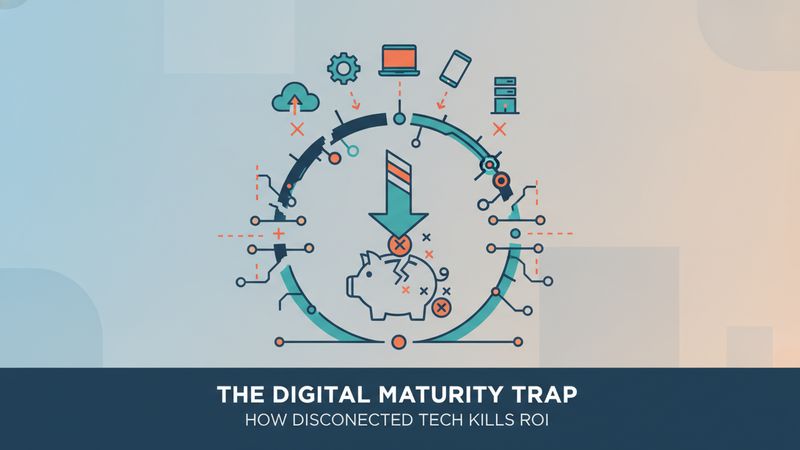
Canadian firms spend billions on digital tools, yet only 10% integrate them into workflows. Here is how leaders turn fragmented tech into bottom-line ROI.
For mid-market executives and operational leaders across Canada, digital modernization has become a staple of quarterly strategy meetings. Yet, despite aggressive capital deployment, achieving measurable digital transformation ROI remains elusive for most enterprises. A recent benchmark study by the Business Development Bank of Canada (BDC) revealed a striking reality: while 96% of Canadian small-and-medium enterprises invest in modern technologies, fewer than 8% have achieved high digital maturity.
Compounding this finding, research from the Canadian Federation of Independent Business (CFIB) indicates that while 92% of businesses utilize digital applications, only 10% have fully integrated those systems across their end-to-end operations. The result is a widening productivity gap where companies continuously purchase new subscriptions and software licenses without capturing operational leverage. Moving from isolated tools to connected digital operations is the primary challenge separating market leaders from organizations caught in digital stagnation.
The Real Cost of Fragmented Digital Operations
When systems operate in silos, the human workforce becomes the manual integration layer. Instead of driving growth, employees spend hours copying data between platforms, reconciling mismatched spreadsheets, and chasing down status updates across disparate customer and inventory tools.
Consider a mid-size logistics and distribution company based in the Greater Toronto Area. Over five years, the business implemented a modern cloud accounting system, a custom customer portal, and third-party warehouse management software. On paper, every department appeared digitized. In reality, order desk staff spent 20% of their day manually rekeying inventory changes from the warehouse system into billing and client dashboards. A single inventory mismatch delayed shipments and eroded customer trust.
This scenario illustrates why 70% to 80% of digital transformation initiatives stall or underdeliver. When software implementations focus on departmental checkboxes rather than integrated business workflows, operational friction multiplies:
- Compounding Human Error: Manual data re-entry introduces friction points, leading to billing discrepancies, delayed customer service response times, and inaccurate reporting.
- Executive Blind Spots: When data remains trapped in functional islands, leadership cannot extract real-time business intelligence to guide pricing, capital allocation, or inventory strategies.
- Lower Return on Investment: CFIB data highlights that organizations with fully integrated core functions generate $2.40 in returns for every $1 invested in technology, compared to significantly lower yields for organizations with fragmented toolsets.
Why Traditional Software Implementations Fail Decision-Makers
Most technology projects fail not because the underlying software is flawed, but because companies tackle integration as an afterthought. When leadership realizes systems do not communicate, they often turn to quick fixes like fragile automation zaps or rigid point-to-point connectors that break with the next software update.
1. The "Bolt-On" Trap
Adding new tools on top of poorly connected legacy infrastructure rarely solves workflow bottlenecks. Without unified data models and unified API middleware, each additional application increases technical complexity and governance overhead.
2. Disregarding Operational Architecture
Many rollouts assume that end users will adapt their daily habits to fit arbitrary software structures. When systems fail to mirror the natural flow of business operations, team members bypass standard procedures and revert to local spreadsheets or shadow processes.
3. Lack of Unified Systems Governance
When technology procurement is distributed across departments without a centralized integration strategy, software overlaps proliferate, data standards degrade, and technical debt compounds.
What Business Leaders Must Do: A Practical Integration Roadmap
Transforming disconnected software into a competitive advantage requires shifting the executive focus from tool adoption to systems integration. Forward-looking organizations follow a structured blueprint to align technology with tangible business outcomes.
Step 1: Map Core Operational Value Streams
Before purchasing new applications, audit the lifecycle of a transaction—from lead capture and quote generation to fulfillment and cash collection. Identify every manual touchpoint, data handoff, and latency bottleneck in the process.
Step 2: Establish an API-First Integration Architecture
Replace brittle point-to-point integrations with a robust, event-driven API middleware layer. This allows legacy ERPs, CRM platforms, and proprietary databases to exchange data reliably without risking core system stability.
Step 3: Consolidate Around a Single Source of Truth
Standardize data governance across the enterprise. Customer records, pricing tables, and inventory metrics must maintain authoritative definitions across every connected application.
Step 4: Measure Outcomes Against Hard Business Metrics
Evaluate digital investments using metrics that matter to the bottom line: order processing cycle times, cost-per-transaction reductions, and employee hours redirected toward revenue-generating activities.
Building an Integrated Foundation with Arepitas Technologies Inc
Closing the gap between technology spending and measurable business performance requires engineering depth combined with operational expertise. For companies seeking to modernize their core processes, Arepitas Technologies Inc serves as a specialized, Toronto-based technology partner.
Arepitas Technologies Inc works alongside mid-market leaders and enterprise teams to untangle complex system architectures, build resilient custom integrations, and engineer bespoke platforms that unify fragmented workflows. Whether your team needs to modernize legacy operational databases, streamline cross-platform data flows, or build scalable web and mobile interfaces, explore how our tailored solutions on our services page can convert fragmented technology into sustainable operating efficiency.
Conclusion: Moving from Digital Activity to Digital Maturity
Achieving lasting business performance does not require an endless stream of new software purchases. It demands that existing systems, workflows, and teams operate in synchrony. By addressing the root causes of disconnected tools and investing in purposeful systems integration, leaders across Ontario and Canada can unlock the true value of their technology investments and build a scalable foundation for long-term growth.
Sources
Need help with digital transformation?
Arepitas Technologies Inc helps companies in Toronto build software, AI features, and digital products that scale.
Book a Free ConsultationRelated Articles
The Digital Transformation Stall: Unlocking Mid-Market ROI
Mid-market enterprises are seeing digital transformation stall under architectural sprawl and data debt. Here is how leaders turn IT spend into measurable ROI.
The Operational Friction Crisis: Fixing Disconnected IT
Discover why Canadian mid-market leaders face crippling operational friction from fragmented software and how workflow modernization unlocks real business ROI.
The Legacy System Drain: Why Rip-and-Replace Fails ROI
Discover why over 70% of legacy software replacements fail to deliver ROI and how Canadian mid-market leaders can modernize iteratively without disruption.