The Great AI Re-Architecture: Legacy IT Debt and Governance Bottlenecks Stall Enterprise Rollouts
Enterprises are running into severe infrastructure bottlenecks as legacy architectures and siloed data stacks force technology leaders to delay high-stakes AI rollouts. Recent data shows that scaling practical enterprise AI requires re-architecting underlying data foundations rather than layering models over legacy debt.
The Hidden Barrier: Legacy Stacks Colliding with AI Demands
Over the past two years, enterprise technology leaders aggressively piloted generative AI and automated decision workflows. However, as organizations transition from isolated proofs-of-concept to enterprise-wide production, they are encountering an unforeseen structural roadblock: their existing data and infrastructure architectures were never built for the real-time throughput, unified governance, and low latency that modern AI models require.
According to a recent industry report highlighted by CIO Dive, nearly three-quarters of enterprise technology leaders indicate that their core infrastructure must be fundamentally revamped to support AI workloads. Crucially, the majority of surveyed organizations have been forced to pause, delay, or cancel key AI projects due to severe compliance, governance, and architectural bottlenecks embedded in legacy platforms.
The Widening Data Readiness Gap
AI output quality is strictly bound to the quality and accessibility of underlying enterprise data. Yet, the foundational layer remains fragmented across disparate on-premises warehouses, mainframe systems, and multi-cloud silos:
- Pervasive Unstructured Data Silos: Most enterprise intelligence is locked in legacy ERPs, static mainframes, and undocumented repositories that modern model orchestration frameworks cannot securely index or query in real time.
- Deficient Data Accessibility: As noted in Adobe's AI and Digital Trends Analysis, only 37% of enterprise leaders report that their organization's data quality and accessibility are currently adequate for scaling AI, with 78% pointing to data integration and quality as their chief implementation roadblock.
- Governance and Compliance Friction: Legacy analytics systems lack continuous, real-time guardrails for data lineage, permission enforcement, and regulatory compliance, creating catastrophic audit and privacy risks when connected to generative models.
Real-World Failure Modes in AI Modernization
Organizations attempting to bypass comprehensive modernization by using generative AI to "magically" refactor legacy code bases are facing severe pushback. Analyst forecasts from Gartner reveal that over 70% of legacy and mainframe modernization projects relying primarily on generative AI tooling are projected to fail due to unrealistic expectations surrounding code translation, business logic comprehension, and architecture dependencies.
Simultaneously, infrastructure costs are spiraling out of control when models are deployed over poorly architected, un-optimized data pipelines that multiply token usage, storage calls, and egress fees across uncoordinated hybrid environments.
Strategic Imperatives for Modern IT Leaders
To move past the pilot phase and realize true ROI, enterprise IT leaders are transitioning from point-solution experimentation to architectural re-engineering:
- Shift from 'Bolted-On' AI to Hybrid Data Fabric: Modernize data ingestion and governance layers with hybrid architectures that bring AI capabilities directly to the data—whether hosted in private clouds, edge nodes, or public hyperscalers—eliminating unnecessary data replication and regulatory risk.
- Adopt Continuous, AI-Integrated Governance: Replace manual, episodic review cycles with automated policy enforcement and runtime metadata tagging to guarantee data provenance across all AI workflows.
- Phased, Value-Driven Modernization: Abandon high-risk 'big bang' migrations in favor of API-first decoupling and targeted refactoring of high-impact systems, ensuring continuous operations and measurable business value.
Sources
Need help with digital transformation?
Arepitas Technologies Inc helps companies in Toronto build software, AI features, and digital products that scale.
Book a Free ConsultationRelated Articles
The Digital Transformation Stall: Unlocking Mid-Market ROI
Mid-market enterprises are seeing digital transformation stall under architectural sprawl and data debt. Here is how leaders turn IT spend into measurable ROI.
The Operational Friction Crisis: Fixing Disconnected IT
Discover why Canadian mid-market leaders face crippling operational friction from fragmented software and how workflow modernization unlocks real business ROI.
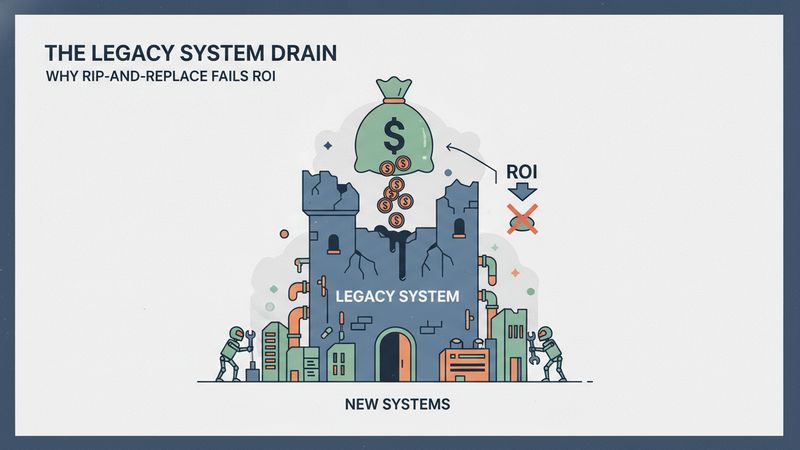
The Legacy System Drain: Why Rip-and-Replace Fails ROI
Discover why over 70% of legacy software replacements fail to deliver ROI and how Canadian mid-market leaders can modernize iteratively without disruption.