The Cyber Insurance Crisis: Why Legacy IT Voids Coverage
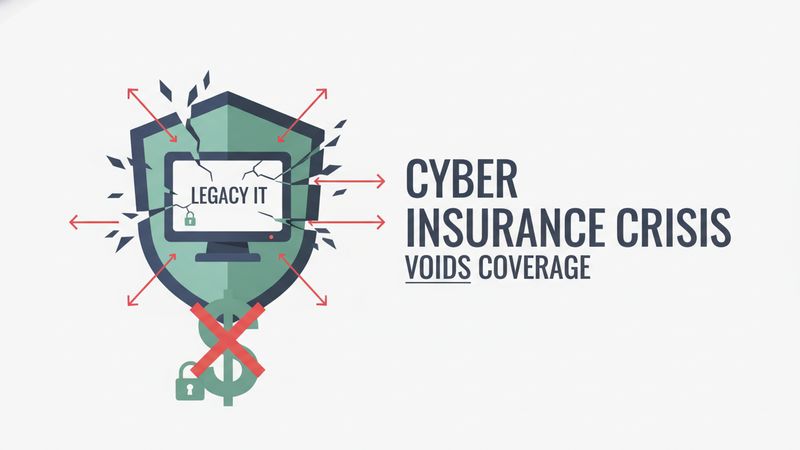
Strict cyber insurance audits are penalizing legacy systems with massive premiums. Here is how Canadian leaders can modernize to safeguard enterprise coverage.
For executive leadership, cyber insurance used to be an administrative formality—a 20-question self-attestation form signed once a year before filing away the renewed policy. Today, that relaxed era is officially over. Facing historic losses from sophisticated ransomware and supply chain attacks, underwriters have transformed renewals into rigorous technical forensic assessments. As a result, meeting modern cyber insurance requirements has become one of the most pressing operational challenges facing Canadian mid-market enterprises.
Underwriters no longer simply ask if you have an active firewall; they run external vulnerability scans, evaluate multi-factor authentication (MFA) enforcement across all privileged accounts, and scrutinize your technology stack for end-of-life (EOL) operating systems and unpatched legacy software. If your core business operations still depend on unsupported databases, unsegmented legacy servers, or outdated frameworks, your organization is facing steep penalty surcharges between 40% and 60%, strict ransomware sub-limits, or outright policy non-renewal.
The Shift from Questionnaire to Forensic Audit
The fundamental business issue is that insurers now treat legacy infrastructure as an unmanaged risk rather than normal technical debt. Recent industry data indicates that while legacy systems represent less than a fifth of insured enterprise assets, they account for roughly two-thirds of material data breaches.
Consider the operational reality for a mid-size distribution company based in the Greater Toronto Area. Operating on an on-premise ERP built a decade ago, the company received a 60-day renewal notice featuring 55 technical validation questions. The insurer’s external attack-surface scan immediately flagged end-of-life .NET runtime dependencies and administrative accounts that bypassed modern identity providers. The company faced an impossible dilemma: accept an immediate 50% premium increase paired with a multi-million-dollar ransomware exclusion clause, or rapidly modernize their vulnerable access layer before the policy lapsed.
This dynamic creates significant financial exposures for business leaders:
- Silent Policy Rescission: Checking "compliant" on an application when legacy sub-systems bypass standard controls creates legal grounds for carriers to void claim payouts after a breach occurs.
- Skyrocketing Self-Insured Retention: Inadequate legacy controls often result in carriers raising deductibles tenfold, forcing companies to shoulder hundreds of thousands in immediate breach remediation costs.
- Regulatory & Sanction Exposure: Under Canadian regulatory frameworks and evolving privacy standards, operational negligence stemming from known unpatched vulnerabilities drastically increases corporate liability.
Why Rip-and-Replace Isn't the Only Answer
When confronted with failing insurance audits, executive teams often panic, assuming they must launch a multi-year, multi-million-dollar replacement of their core business software. However, traditional "big-bang" system replacements take 18 to 36 months to complete—far too slow to satisfy an insurer’s 60-day compliance remediation window.
Progressive organizations instead take a strategic modernization approach that insulates mission-critical systems while systematically eliminating exposure points:
1. Modern API Gateways and Identity Decoupling
Rather than rebuilding a functioning legacy ERP from scratch, organizations deploy secure cloud-native API wrappers that enforce centralized Single Sign-On (SSO) and continuous Multi-Factor Authentication across all administrative and user workflows. This satisfies underwriter identity management mandates without disrupting ongoing operations.
2. Network Isolation and Zero Trust Segmentation
Underwriters penalize legacy systems primarily because an attacker who breaches an outdated server can easily move laterally across the entire corporate network. Encapsulating legacy workloads inside containerized, micro-segmented virtual private clouds (VPCs) blocks lateral movement, turning high-risk endpoints into controlled internal assets.
3. Incremental Core Modernization
By targeting the specific modules that run on deprecated frameworks or unpatched runtimes, teams can refactor high-risk components into modern microservices. This eliminates end-of-life exclusions while steadily lowering long-term maintenance costs.
Actionable Steps for Decision-Makers Ahead of Renewal
If your organization is within six months of its next cyber insurance renewal, proactive technical alignment is critical. Business leaders should execute a structured readiness plan:
- Conduct a Technical Debt and EOL Audit: Map every production server, database, and custom internal application against active vendor support lifecycles. Identify every system that cannot natively support conditional access or modern logging.
- Establish Compensating Security Controls: Where legacy applications cannot be modified directly, document concrete compensating controls—such as restricted VPN tunnels, immutable cloud backups, and behavioral endpoint protection (EDR)—to present to underwriters.
- Prioritize High-ROI Modernization Roadmaps: Partner with engineering specialists to decouple legacy user interfaces and databases, establishing secure web interfaces that satisfy compliance while boosting employee productivity.
Modernize Legacy Infrastructure with Arepitas Technologies Inc
Navigating modern cybersecurity mandates does not require halting business growth or draining capital on prolonged migrations. Operating out of Toronto, Arepitas Technologies Inc helps mid-market and enterprise organizations throughout Canada bridge the gap between mission-critical legacy software and modern cloud standards.
From building secure API integration layers and zero-trust web architectures to executing phased application modernization programs, Arepitas Technologies transforms high-risk technical debt into resilient digital assets. Explore our end-to-end capabilities by visiting our custom software and cloud modernization services to secure your operations and pass your next audit with confidence.
Sources
Need help with cybersecurity?
Arepitas Technologies Inc helps companies in Toronto build software, AI features, and digital products that scale.
Book a Free ConsultationRelated Articles
The Breach Containment Lag: Stemming Rising Cyber Costs
With Canadian data breach costs reaching CA$7.11M, a prolonged breach containment lag drains company margins. Here is how leaders regain operational control.
The Vendor Risk Blindspot: Protecting Enterprise Margins
Third-party cyber risk is driving Canadian data breach costs to record highs. Learn how to eliminate vendor blindspots and protect your enterprise margins.
Shadow AI Governance: Securing Unvetted Enterprise Agents
Enterprise shadow AI governance is now urgent as power users and unvetted agents bypass IT security, escalating corporate data leakage and compliance risks.