The Breach Containment Lag: Stemming Rising Cyber Costs
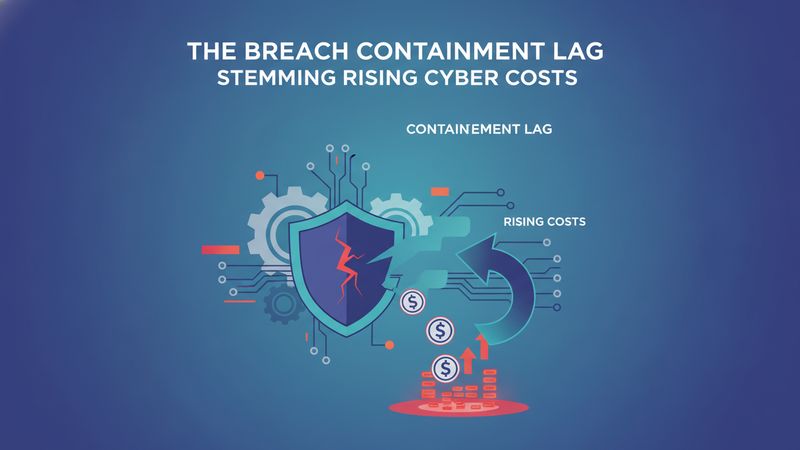
With Canadian data breach costs reaching CA$7.11M, a prolonged breach containment lag drains company margins. Here is how leaders regain operational control.
For executive leadership teams across Canada, cybersecurity discussions frequently stall at the perimeter. Boards and operations directors review spend on endpoint antivirus software, annual penetration test certifications, and multi-factor authentication rollouts. Yet when an operational compromise occurs, financial exposure is rarely determined by the initial perimeter intrusion alone. The true commercial damage stems from the breach containment lag—the prolonged, silent window between an initial security compromise and its complete eradication.
According to findings in the 2026 IBM Cost of a Data Breach Report, Canadian organizations now pay a record average of CA$7.11 million per incident, marking the highest financial threshold ever recorded in the country. More revealing is the operational friction behind that figure: the average breach lifecycle stretched to 205 days—roughly seven months of undetected dwell time and sluggish containment. In sectors like energy, industrial manufacturing, and enterprise technology, average breach bills climbed even higher, ranging between CA$8.89 million and CA$9.21 million. For Canadian mid-market leaders managing lean balance sheets, this containment lag represents an unsustainable drain on operational margins.
The Hidden Arithmetic of the 205-Day Containment Cycle
When a cyber incident becomes public, headlines fixate on ransom figures. In practice, however, Canadian business data shows that the ransom itself represents only a fraction of the total invoice. The compounding costs of an extended breach containment lag stem from the structural friction of legacy architecture, unmonitored integration sprawl, and manual investigation processes.
Every week an undetected intruder lingers inside a company network compounds operational vulnerability through three distinct cost multipliers:
- Escalating forensic and discovery overhead: As dwell time drags out, security forensics teams must parse through months of fragmented application logs, database backups, and cloud audit trails. The longer attackers move laterally, the harder and more expensive it becomes to establish proof of non-compromise for insurers and regulators.
- Supply-chain liability exposure: Modern businesses run on interconnected digital ecosystems. The IBM data highlights that supply chain compromises added an average CA$368,000 to total breach costs in Canada. When a compromise persists undetected, an organization inadvertently exposes its downstream partners, triggering third-party breach liability clauses and contract terminations.
- Business interruption and idle enterprise capacity: While engineering teams scramble to quarantine servers and patch zero-day vulnerabilities across outdated codebases, normal business functions grind to a halt. In industries with tight SLA penalties, days spent in operational paralysis destroy quarterly EBITDA far faster than any direct remediation fee.
As reported by Global News, Canadian organizations facing cyber compromises experienced an 8% increase in exposed customer and operational records year over year. The math is simple: every additional day of containment lag expands the attack surface, turning what should have been an isolated code patch into an enterprise-wide crisis.
Real-World Scenario: The Cost of Fragmented Visibility in Ontario
Consider the experience of a mid-sized specialized logistics and freight provider operating out of the Greater Toronto Area. The company maintained a proprietary customer tracking portal connected to an older inventory ERP system, alongside a modern third-party billing gateway.
During an infrastructure update, an external vendor credential was compromised. Because the company's application architecture lacked central observability and granular API permission boundaries, the intruder navigated undetected between staging environments and core order databases for 130 days. When an automated ransomware script finally locked the logistics dispatch database, operations ceased entirely.
Over the nine days required to restore databases from cold backups and clean compromised code repositories, the company incurred:
- CA$280,000 in immediate customer breach notification, legal counsel, and specialized forensic audit retainers.
- CA$340,000 in missed dispatch revenue, customer SLA liquidated damages, and temporary manual warehouse staffing.
- CA$190,000 in unbudgeted external developer emergency fees to rewrite the corrupted integrations.
No ransom was paid, yet the total balance sheet impact exceeded CA$810,000. Had the company implemented modern telemetry and microsegmentation, anomalous database querying would have triggered automated credential isolation within hours, cutting total cost impact by over 75%.
Modernizing Architecture to Shrink Containment Times
The gap between organizations crippled by breaches and those that bounce back cleanly comes down to architecture. Organizations that deployed automated security orchestration and AI-enabled threat containment experienced breach costs that were CA$3.41 million lower on average—saving weeks of downtime by detecting incidents in 124 days and containing them in 57 days, compared to 154 and 71 days for unautomated environments.
Closing the breach containment lag does not require million-dollar enterprise licenses; it requires purposeful software engineering and architectural modernization:
1. Shift from Perimeter Audits to Telemetry by Design
Annual compliance checklists create false security comfort. Mid-market engineering teams must build continuous telemetry into custom software, API endpoints, and web platforms. By instrumenting applications to alert on unexpected payload volumes or unusual identity queries, operators detect compromises when they start, not months later.
2. Isolate Critical Business Logic Through Microsegmentation
Monolithic architectures allow an exploit in an external-facing customer portal to bleed directly into back-office financials. Modernizing code into modular, isolated services with strict Zero Trust access tokens ensures that even if an edge credential leaks, lateral movement across the company's data layer is blocked by design.
3. Implement Automated Containment Circuit Breakers
When an anomalous credential burst occurs at 2:00 AM on a long weekend, waiting for human intervention guarantees failure. Systems should feature automated circuit breakers that revoke suspected API access tokens and isolate affected database pools instantly, halting data extraction before human analysts even review the alert log.
Turning Resilience Into a Competitive Moat
For business leaders across Ontario and Canada, managing cybersecurity is no longer an IT maintenance chore—it is balance sheet risk management. As federal regulatory frameworks like the Critical Cyber Systems Protection legislation take shape and commercial clients scrutinize vendor security disclosures, organizations with short containment lifecycles earn substantial trust advantages.
Transitioning legacy application codebases and siloed architectures into hardened, modern platforms requires practical technical leadership. As a Toronto-based software engineering and modernization consultancy, Arepitas Technologies Inc partners with growing organizations to audit architectural vulnerabilities, modernize legacy code, and engineer resilient systems designed to stop operational bleeding before it drains margins. To see how our technical team can harden your internal platforms, explore our custom engineering and modernization services.
The difference between a minor incident and a multi-million-dollar headline is the speed of resolution. By eliminating architectural blind spots and addressing containment lag now, executives safeguard their margins, protect brand reputation, and ensure uninterrupted business growth.
Sources
Need help with cybersecurity?
Arepitas Technologies Inc helps companies in Toronto build software, AI features, and digital products that scale.
Book a Free ConsultationRelated Articles
The Vendor Risk Blindspot: Protecting Enterprise Margins
Third-party cyber risk is driving Canadian data breach costs to record highs. Learn how to eliminate vendor blindspots and protect your enterprise margins.
The Cyber Insurance Crisis: Why Legacy IT Voids Coverage
Strict cyber insurance audits are penalizing legacy systems with massive premiums. Here is how Canadian leaders can modernize to safeguard enterprise coverage.
Shadow AI Governance: Securing Unvetted Enterprise Agents
Enterprise shadow AI governance is now urgent as power users and unvetted agents bypass IT security, escalating corporate data leakage and compliance risks.