Closing the Productivity Gap: Stop Buying More Tools
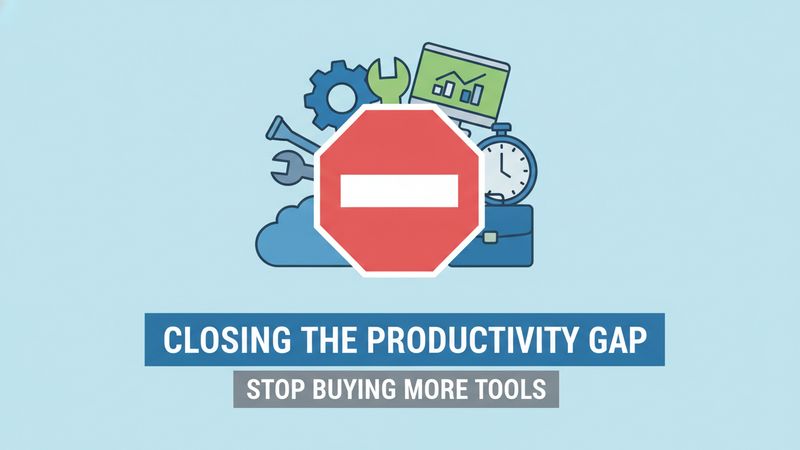
Canadian companies face a widening productivity gap. Discover why buying more software fails and how custom workflow integration drives measurable growth.
Canadian business leaders are confronting an urgent economic dilemma: the national productivity gap continues to widen even as enterprise technology spending reaches historic highs. According to recent data from Statistics Canada's Canadian Survey on Business Conditions, business adoption of artificial intelligence surged to 19.2%—effectively tripling within two years and keeping pace with U.S. adoption rates. Yet, Canadian worker output per hour remains stubbornly low at barely 71% of U.S. levels, having expanded by only 3% over the past decade compared to 18% in the United States.
For executives across Toronto, Ontario, and nationwide, the takeaway is stark: simply procuring digital tools does not translate into operational velocity. When technology investments are layered on top of outdated processes without purposeful integration, they create administrative friction rather than competitive advantage.
The Technology Procurement Trap
Most enterprise technology initiatives fail to deliver a measurable return on investment because organizations mistake software acquisition for business modernization.
A study conducted by Deloitte revealed a striking imbalance in enterprise budgets: 93% of digital and automation spending is allocated strictly to software licensing and infrastructure procurement, leaving a mere 7% for process redesign, integration, and workforce readiness.
This procurement-first mentality leads to several distinct operational bottlenecks:
- Fragmented Process Chains: When departments independently adopt specialized point solutions, work becomes fragmented across incompatible interfaces, forcing employees to spend hours manually reconciling information.
- Superficial Tool Adoption: Employees default to manual workarounds and spreadsheets when off-the-shelf software fails to match the actual nuances of day-to-day operations.
- Inflated Software Overhead: Companies pay premium per-seat licensing fees for enterprise suites while utilizing less than 30% of their functional capabilities.
As TD Economics highlighted in its recent report on enterprise modernization, durable productivity gains require systematic integration—embedding technology directly into core operational workflows rather than deploying disconnected apps.
Real-World Scenario: The Logistics Disconnect in the GTA
Consider a mid-sized supply chain and commercial distribution enterprise operating across the Greater Toronto Area. Over eighteen months, the leadership team invested heavily in modern cloud software: a top-tier customer relationship management (CRM) platform, an automated route planner, and an off-the-shelf inventory tracker.
On paper, the company had fully digitized. In practice, dispatchers were copying delivery manifests from the CRM into Excel sheets to bridge gaps with the routing platform, while warehouse managers spent four hours each day resolving inventory discrepancies between disparate databases.
Despite spending over $180,000 annually on software subscriptions, cycle times slowed by 14%, and order fulfillment errors increased. The problem was not the software capabilities; it was the absence of a unified, tailor-made workflow that connected their physical operations to their digital records.
Only when the organization replaced disjointed tools with an integrated operational portal did performance turn around: order processing times dropped by 45%, and administrative overhead decreased by $120,000 annually.
How Canadian Business Leaders Can Bridge the Gap
Closing the operational efficiency divide requires shifting from reactive software buying to strategic system architecture. Executive teams should prioritize three concrete actions:
1. Audit Friction Points Before Budgeting Tools
Before approving new software line items, conduct an end-to-end audit of core business workflows. Identify exactly where employees experience repetitive manual data entry, handoff delays, or reconciliation bottlenecks. Software must solve a verified operational impediment, not an abstract goal.
2. Prioritize Workflow Integration Over Feature Density
Rather than adding another general-purpose application, focus on connecting existing data stores into cohesive interfaces. Purpose-built internal portals and streamlined web applications consolidate disparate data sources, allowing staff to complete critical transactions without toggling between multiple platforms.
3. Tie Every Digital Initiative to Concrete Unit Economics
Frame technology projects around clear financial metrics: cost per transaction, order turnaround time, customer onboarding speed, or administrative labor hours saved. Tracking these indicators prevents pilot paralysis and ensures development resources directly impact the bottom line.
Modernize Your Core Operations With Arepitas Technologies Inc
Bridging the productivity gap does not require larger software budgets; it requires engineering solutions tailored to how your business actually runs.
Based in Toronto, Arepitas Technologies Inc helps mid-market and enterprise organizations design, build, and modernize custom web platforms, automated workflows, and high-performance digital systems. By replacing disconnected off-the-shelf tools with purpose-engineered digital infrastructure, Arepitas Technologies Inc enables Canadian businesses to eliminate operational bottlenecks and drive sustained profitability.
Sources
- •AI Adoption Won't Fix Canada's Productivity Problem Without Workforce Readiness
- •TD Economics: AI in Canada - Sustained Productivity Requires Systematic Integration
- •The Hub: Canadian businesses closing adoption gap with US, but productivity gap remains
- •Sage Report: Canada's Digital & AI Imperative - Closing the Productivity Gap
Need help with digital transformation?
Arepitas Technologies Inc helps companies in Toronto build software, AI features, and digital products that scale.
Book a Free ConsultationRelated Articles
The Digital Transformation Stall: Unlocking Mid-Market ROI
Mid-market enterprises are seeing digital transformation stall under architectural sprawl and data debt. Here is how leaders turn IT spend into measurable ROI.
The Operational Friction Crisis: Fixing Disconnected IT
Discover why Canadian mid-market leaders face crippling operational friction from fragmented software and how workflow modernization unlocks real business ROI.
The Legacy System Drain: Why Rip-and-Replace Fails ROI
Discover why over 70% of legacy software replacements fail to deliver ROI and how Canadian mid-market leaders can modernize iteratively without disruption.