The Cloud Sovereignty Trap: Protecting Canadian Data
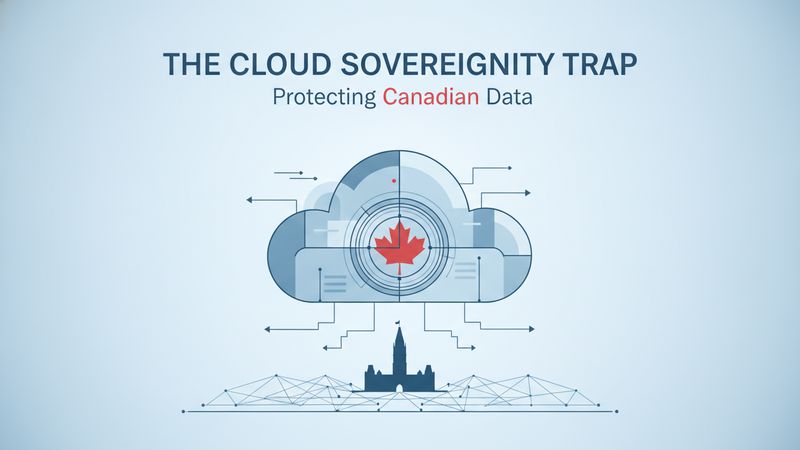
Hosting in Canadian data centres isn't enough. Discover why leaders face cross-border compliance risks and how sovereign cloud architecture shields margins.
For Canadian business leaders, selecting a domestic availability zone such as AWS Canada Central in Toronto or Azure Canada East in Montreal has long served as a shorthand for data compliance. Most executive teams assume that checking the local region box ensures full privacy, satisfies regulatory mandates, and shields proprietary data from foreign jurisdiction. However, as enterprise procurement teams, public sector bodies, and regulators enforce stringent compliance rules, that assumption is triggering expensive architectural dead-ends. Canadian companies are discovering that data residency does not equate to true cloud sovereignty.
Under international legal mechanisms such as the United States CLOUD Act, foreign governments can legally compel American parent technology providers to produce stored records regardless of where physical servers are located. At the same time, Canada's evolving privacy reforms and federal procurement frameworks (such as Protected B cloud requirements) demand rigorous guarantees around administrative access, cryptographic key custody, and tenant isolation. When mid-market leaders and fast-growing software companies fail to understand this distinction, they risk stalled enterprise sales, compliance fines, and costly emergency software re-architectures.
Data Residency vs. Cloud Sovereignty: The Costly Executive Confusion
To make informed infrastructure investments, decision-makers must separate the physical location of hardware from legal and operational authority.
- Data Residency: Defines purely physical geography. It confirms that files, database instances, and compute nodes are located inside Canadian borders. While necessary for reducing network latency and meeting basic geographic tick-boxes, residency alone provides no legal shield against extraterritorial subpoenas served to foreign-headquartered parent corporations.
- Cloud Sovereignty: Governs jurisdictional, technical, and operational control. It dictates which legal framework has ultimate authority over data access, who possesses decryption keys, and who holds privileged administrative root access to the hypervisor and underlying network fabric.
According to an analysis on Canadian cloud sovereignty and data residency by VEXXHOST, true sovereignty is an infrastructure control model rather than a geographic label. If a foreign entity holds administrative access or root keys, the data remains vulnerable to external legal interventions—regardless of where the data centre resides.
For mid-sized firms in financial technology, healthcare, legal services, and supply chain management across Ontario, this distinction is no longer theoretical. When pursuing enterprise contracts with Canadian banks, hospital networks, or provincial agencies, security audits routinely stall when vendors cannot prove sovereign isolation. Losing a $250,000 to $1,000,000 multi-year enterprise contract during late-stage procurement audits is often the painful event that exposes this infrastructure blind spot.
The Hidden Operational and Financial Exposure
The architectural risks of passive cloud deployments extend beyond direct regulatory fines into everyday operational overhead:
- Silent Pipeline Leakage: Many engineering teams maintain application databases in Canada Central but inadvertently route secondary workloads—such as logging aggregation, error reporting, vector database queries, or automated backup snapshots—to primary American infrastructure like Northern Virginia (
us-east-1). This compromises compliance across the entire pipeline. - The Decryption Key Vulnerability: Relying on default, cloud-provider-managed encryption keys leaves data open to compelled decryption orders. As outlined in an executive brief on data residency versus sovereignty by Carbon60, organizations that do not manage their own keys in independent Canadian repositories cannot prevent third-party disclosures under foreign laws.
- Emergency Remediation Expenses: Reworking a monolithic or poorly segmented cloud environment under audit pressure typically costs 3x to 5x more than building sovereign-by-design systems from the outset. Emergency re-platforming often diverts core engineering teams away from revenue-generating features for two to four months.
Decision Framework: Evaluating Your Sovereign Infrastructure Posture
Executive leadership does not need to master low-level networking, but managers must ask direct architectural questions to evaluate business risk:
1. Key Custody and Cryptographic Isolation
Do you utilize Customer-Managed Encryption Keys (CMEK) or Bring-Your-Own-Key (BYOK) configurations where encryption keys are stored and managed in independently controlled Hardware Security Modules (HSMs) located inside Canada? If your cloud hosting provider holds the master key, they can be compelled to decrypt your assets without your explicit operational consent.
2. Comprehensive Data-Flow Auditing
Where do your telemetry streams, disaster recovery cold storage, and observability pipelines route their data? An audit must verify that auxiliary infrastructure—such as vector indexes used in AI retrieval-augmented generation (RAG) models, application trace logs, and remote failover points—remains strictly bound to approved regional boundaries.
3. Portability and Vendor Independence
Are critical workloads built with portable, containerized infrastructure (such as standard Kubernetes and Infrastructure-as-Code patterns), or are they deeply coupled to proprietary hyperscaler services? According to research from the Macdonald-Laurier Institute on Canadian cloud policy, establishing technical control and workload portability is the most effective safeguard against regulatory overreach and unexpected policy shifts.
4. Administrative Access and Operator Governance
Who possesses the privileged credentials to troubleshoot hypervisors and production networks during off-hours? Enforcing strict identity governance and role-based access controls ensures that operational maintenance cannot be seamlessly offshored to jurisdictions with conflicting privacy regulations.
Modernizing Cloud Architecture for Long-Term Value
Transitioning from simple geographic residency to a resilient, sovereign posture requires intentional engineering. For most growing companies, internal product teams are already stretched thin building customer-facing functionality and maintaining existing release schedules. Assigning junior teams or overburdened DevOps leads to overhaul compliance architecture often results in misconfigured VPCs, latency bottlenecks, or runaway egress costs.
This is where engaging an experienced technical partner proves essential. Arepitas Technologies Inc, a Toronto-based software engineering and cloud consulting practice, helps Canadian businesses design, audit, and modernize compliant cloud architectures. By structuring systems that balance regulatory sovereignty, performance, and cost predictability, organizations can bid on high-value public sector and enterprise contracts with confidence.
Explore our tailored software and infrastructure engineering offerings across our /services page, or schedule an architectural assessment to ensure your enterprise workloads are secure, compliant, and positioned for sustainable market expansion.
Sources
Need help with cloud infrastructure?
Arepitas Technologies Inc helps companies in Toronto build software, AI features, and digital products that scale.
Book a Free ConsultationRelated Articles
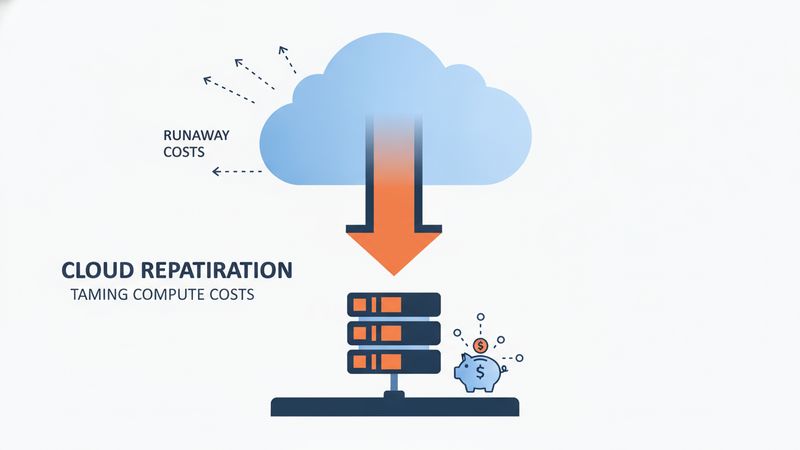
The Cloud Repatriation Shift: Taming Runaway Compute Costs
Canadian leaders are rethinking all-in cloud strategies as runaway egress fees and compute bills push critical workloads back to hybrid architectures.
Hybrid AI Infrastructure: Taming Enterprise AI Overruns
Discover why adopting hybrid AI infrastructure is essential for enterprise IT leaders seeking to tame surging inference costs and legacy cloud bottlenecks.
The Agentic AI Cloud Shock: Why Enterprise Modernization Is Shifting to Granular FinOps and Legacy Decoupling
As autonomous AI agent workflows and GenAI workloads accelerate cloud consumption beyond traditional forecasts, enterprises are overhauling brittle legacy architectures and implementing automated FinOps governance to protect operational margins.