The Cloud Repatriation Shift: Taming Runaway Compute Costs
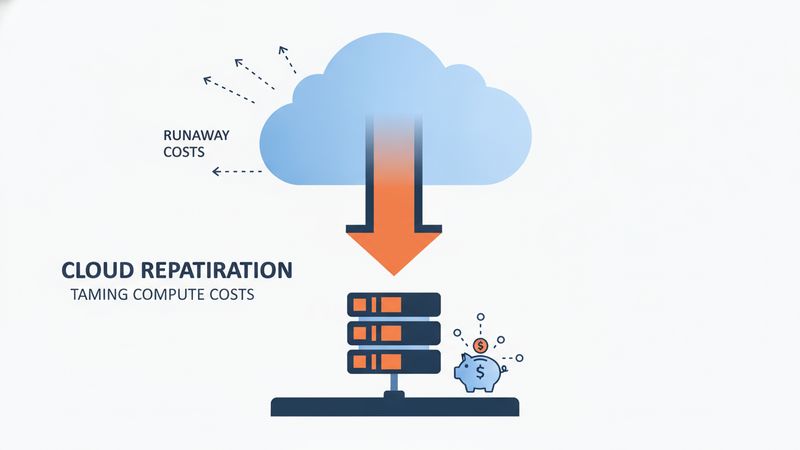
Canadian leaders are rethinking all-in cloud strategies as runaway egress fees and compute bills push critical workloads back to hybrid architectures.
For more than a decade, the standard corporate playbook dictated a strict "cloud-first" mandate. Enterprise technology leaders migrated core databases, internal workflow applications, and customer portals directly into public hyperscaler environments under the promise of elasticity, reduced overhead, and hands-off maintenance. However, as organizations scale, the economic reality of public cloud computing is forcing an urgent strategic pivot. Today, cloud repatriation—the deliberate migration of steady-state workloads and sensitive databases from public clouds back to private clouds or co-located infrastructure—has moved from a fringe technical debate to a top boardroom priority.
Recent enterprise data reveals that over 86% of IT leaders now plan to shift select workloads away from public hyperscalers, with 89% expanding their private and on-premises footprint. The driver is rarely dissatisfaction with cloud capabilities; rather, it is the realization that variable pay-as-you-go pricing models become penalizingly expensive for predictable, high-volume operations.
The Unforgiving Economics of Hyperscaler Sprawl
Public cloud infrastructure is exceptionally effective for volatile workloads, rapid prototyping, and dynamic scaling. But when applied indiscriminately to 24/7 steady-state operations, the total cost of ownership (TCO) often compounds out of control.
- Punitive Data Egress Fees: Hyperscalers make data ingestion seamless and free, but charge substantial tolls whenever that data moves between regions, external APIs, or customer-facing endpoints. For data-intensive businesses, egress charges frequently account for 20% to 35% of the total monthly cloud invoice.
- The Steady-State Tax: Running consistent, predictable relational databases and continuous background batch processes on rented compute instances incurs a substantial premium compared to purpose-built, dedicated infrastructure.
- Unused Capacity & Over-Provisioning: Industry surveys indicate that approximately 27% of enterprise cloud spending is wasted on idle instances, abandoned storage buckets, and over-provisioned memory buffers.
Scenario: The Growing Mid-Market Squeeze in Ontario
Consider a mid-market distribution and logistics company based in Toronto. Three years ago, leadership migrated their core inventory management and order routing systems entirely to a major public cloud. As shipping volume doubled across Ontario and automated tracking pings surged, their monthly infrastructure expense quintupled from $18,000 to nearly $95,000.
Nearly half of that bill stemmed not from core compute improvements, but from cross-zone data transfer fees and continuously running database instances that never required elastic auto-scaling. By conducting a structured infrastructure audit, decoupling their data ingestion layer, and repatriating steady-state operational databases into a secured, co-located private cluster, the company was able to reduce its annual IT spend by over $400,000 while cutting processing latency by 35%.
Canadian Data Sovereignty and Compliance Pressures
Beyond cost containment, Canadian organizations face escalating regulatory and data governance imperatives. In regulated sectors—including financial services, healthcare, and insurance—compliance mandates increasingly demand strict visibility over data residency and audit trails.
Recent industry surveys find that 99% of senior IT decision-makers identify data sovereignty as a primary consideration in infrastructure strategy. Storing proprietary customer records or regulated intellectual property across opaque multi-tenant cloud regions can complicate compliance under Canadian privacy frameworks and create unwanted exposure to foreign jurisdictional queries. Private and sovereign hybrid architectures provide executives with complete control over where sensitive assets reside, how encryption keys are managed, and who accesses the underlying hardware.
Practical Steps to Execute a Workload Rebalancing Strategy
Cloud repatriation is not an all-or-nothing proposition. Modern enterprise infrastructure relies on a hybrid model that captures the agility of public clouds alongside the cost predictability and security of private platforms. Technology leaders must adopt a systematic approach to rebalance their footprint:
- Categorize Workloads by Demand Profile: Audit your operational portfolio. Highly variable, bursty workloads (such as seasonal campaign front-ends or experimental machine learning pipelines) belong in the public cloud. Predictable, always-on workloads (such as core ERPs, primary SQL databases, and internal enterprise dashboards) are prime candidates for repatriation.
- Containerize and Decouple Architecture: Avoid relying on proprietary cloud services that enforce vendor lock-in. Standardizing workloads on open container standards (like Kubernetes and Docker) allows your engineering team to deploy applications across public clouds and dedicated servers without extensive refactoring.
- Calculate True 3-Year Total Cost of Ownership: Compare direct infrastructure licensing, bandwidth charges, maintenance labor, and disaster recovery costs. A comprehensive financial comparison typically reveals clear break-even timelines for high-throughput applications.
- Automate Infrastructure Deployment: Implement modern Platform Engineering practices and Infrastructure as Code (IaC) to ensure private environments deliver the same developer velocity and self-service convenience as hyperscaler portals.
Moving from Reactive Spending to Intentional Infrastructure
The era of blind cloud migration is over. Progressive Canadian businesses are taking back control of their infrastructure budgets by aligning workload placement with measurable business outcomes rather than platform hype. By adopting a hybrid architecture that pairs public cloud flexibility with private steady-state compute, organizations can slash recurring operating overhead and build lasting competitive advantage.
Achieving this balance requires an experienced technology partner who understands both modern cloud architecture and legacy systems integration. Based in Toronto, Arepitas Technologies Inc helps mid-market enterprises and growing companies evaluate workload economics, modernize legacy systems, and implement high-performance, cost-effective infrastructure architectures. Explore our custom software and modernization services to discover how your business can optimize infrastructure costs and reclaim engineering agility.
Sources
Need help with cloud infrastructure?
Arepitas Technologies Inc helps companies in Toronto build software, AI features, and digital products that scale.
Book a Free ConsultationRelated Articles
The Cloud Sovereignty Trap: Protecting Canadian Data
Hosting in Canadian data centres isn't enough. Discover why leaders face cross-border compliance risks and how sovereign cloud architecture shields margins.
Hybrid AI Infrastructure: Taming Enterprise AI Overruns
Discover why adopting hybrid AI infrastructure is essential for enterprise IT leaders seeking to tame surging inference costs and legacy cloud bottlenecks.
The Agentic AI Cloud Shock: Why Enterprise Modernization Is Shifting to Granular FinOps and Legacy Decoupling
As autonomous AI agent workflows and GenAI workloads accelerate cloud consumption beyond traditional forecasts, enterprises are overhauling brittle legacy architectures and implementing automated FinOps governance to protect operational margins.